

Car Amplifier Installation Riverside CA – At Advanced Car Stereo Riverside, we install car amplifiers to bring more power, clarity, and control to your sound system. Whether you’re upgrading your speakers, adding a subwoofer, or planning a high-output bass system, our team can help you choose an amplifier that fits your vehicle and listening goals.
📍 10555 Magnolia Ave, Riverside CA 92505 | 📞 (951) 358-0516 | Open 7 Days 9AM–6PM
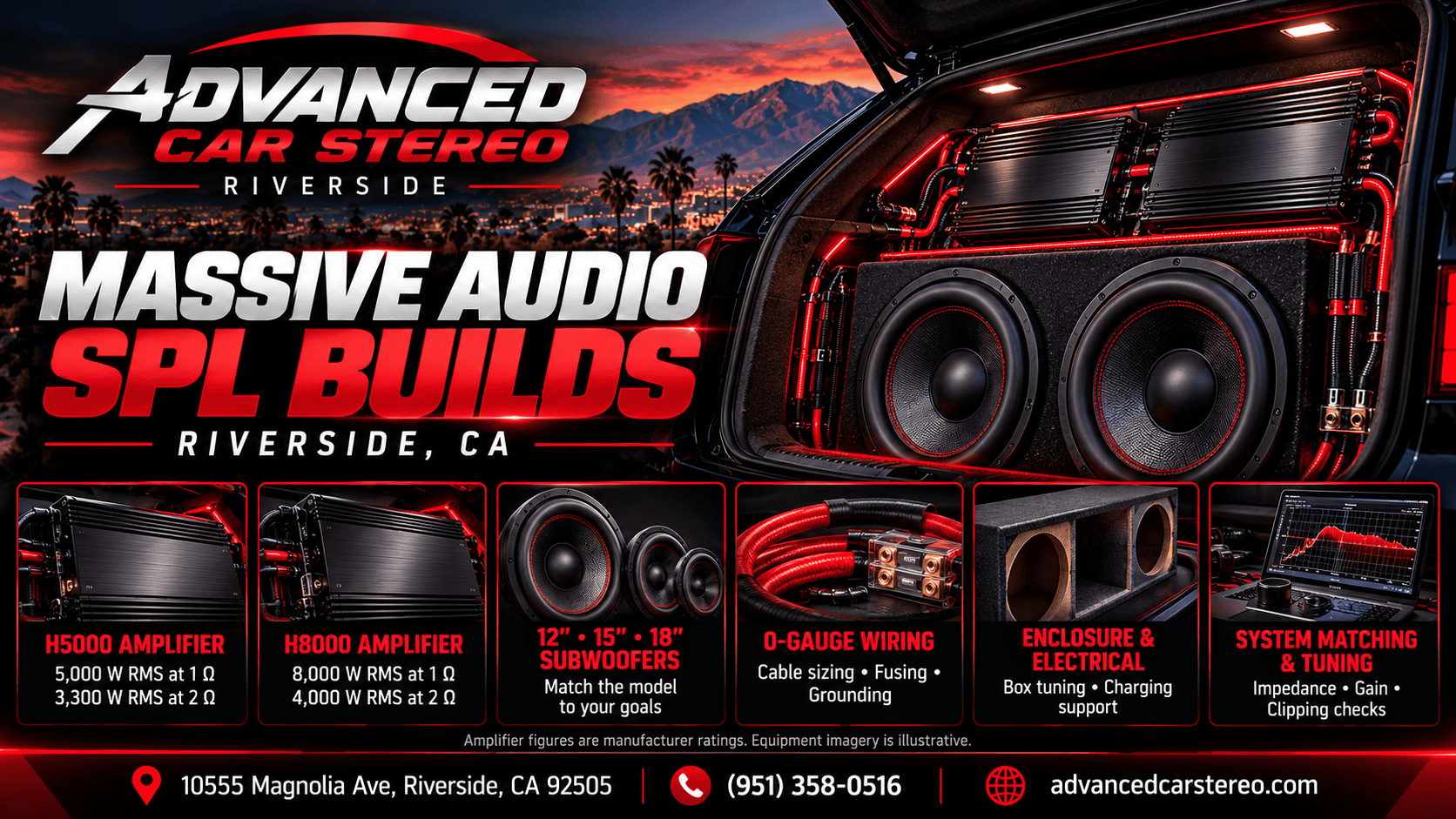
Massive Audio SPL Builds in Riverside: H5000, H8000, Big Subs and 0-Gauge Wiring
When the bass drops, you should feel the system come alive. Deep impact, strong output, and a clean installation start with a complete plan: the amplifier, subwoofers, enclosure, electrical supply, wiring, and tuning must work together.
For drivers researching an SPL car audio installation in Riverside, Massive Audio offers options ranging from everyday bass upgrades to demanding demonstration builds. Its H5000 and H8000 amplifiers and 12-, 15-, and 18-inch subwoofers deserve a closer look—but choosing the largest number on the box is only the beginning.
At Advanced Car Stereo Riverside, contact us to discuss your vehicle, available space, and the bass experience you want.
What Is SPL, and What Kind of Bass Do You Want?
SPL means sound pressure level. In car audio, an SPL-focused system aims for high acoustic output, especially in the bass range.
A daily music system and a competition setup have different goals. A daily build should reproduce the music you enjoy across a useful range. A competition build may prioritize measured output at particular frequencies and must be planned around the event’s rules.
Decide whether you want deep daily bass, a show vehicle, or a competition project. That choice affects enclosure tuning, equipment quantity, electrical demand, and how much vehicle space you need.
Massive Audio H5000 and H8000 Amplifiers
Massive Audio publishes these specifications:
| Specification | H5000 | H8000 |
| Channels | One | One |
| RMS output at 1 ohm | 5,000 watts | 8,000 watts |
| RMS output at 2 ohms | 3,300 watts | 4,000 watts |
| Listed minimum impedance | 1 ohm | 1 ohm |
| Power and ground inputs | 0 AWG | 0 AWG |
These are manufacturer ratings, not an independently measured output guarantee for your vehicle. Actual output depends on supply voltage, load, signal, and operating conditions.
The H5000 is worth considering when its output at the intended load fits the subwoofer system and electrical budget. The H8000 provides a higher published 1-ohm rating for more demanding designs. At 2 ohms, however, compare the listed 3,300- and 4,000-watt ratings rather than assuming the H8000 always produces 8,000 watts.
Both product pages list voltage displays and clipping/protection indicators. Those tools help monitor operation, but cannot replace a correctly designed and tested installation.
Choose by RMS output at the actual load. Peak ratings are not the basis for matching an amplifier to subwoofers.
Massive Audio Subwoofers: 12 Inches and Up
Massive Audio’s main subwoofer collection includes the following 12-inch-and-larger listings. D2 and D4 mean dual 2-ohm and dual 4-ohm voice coils; the final amplifier load depends on how those coils and multiple drivers are connected.
| Size | Model | Published RMS handling | Voice coils |
| 12-inch | GT12 | 500 W | D4 |
| 12-inch | GTS12 | 300–400 W; 350 W ideal | D4 |
| 12-inch | GTX122H | 600–800 W | D2* |
| 12-inch | GTX124H | 800 W | D4 |
| 12-inch | GTR122 | 1,000 W | D2 |
| 12-inch | GTR124 | 1,000 W | D4 |
| 12-inch | H124 | 1,500 W | D4 |
| 12-inch | H122X | 2,000 W | D2 |
| 12-inch | H124X | 2,000 W | D4 |
| 12-inch | H122XR | 3,000 W | D2 |
| 12-inch | H124XR | 3,000 W | D4 |
| 12-inch | HIPPOXL122R | 3,000 W | D2 |
| 12-inch | BOA121R | 8,000 W | Dual 1 ohm |
| 12-inch | BOA122R | 8,000 W | D2 |
| 15-inch | KILOX154 | 1,000 W | D4 |
| 15-inch | HIPPOXL152 | 2,000 W | D2 |
| 15-inch | H152X | 2,000 W | D2 |
| 15-inch | H154X | 2,000 W | D4 |
| 15-inch | H152XR | 3,000 W | D2 |
| 15-inch | HIPPOXL152R | 3,000 W | D2 |
| 15-inch | BOA152R | 8,000 W | D2 |
| 18-inch | BOA182R | 8,000 W | D2 |
The GTX122H product page specifies D2, while its collection card says D4. Confirm the supplied unit’s label and current manual before wiring. The GTS12 page also varies between its 300-watt headline and its 300–400-watt specification range.
The collection additionally shows an archived TKO12S4 12-inch model at 300 W with a single 4-ohm designation. Separate, older BOA pages retain BOA121, BOA121N, BOA151, BOA151N, BOA151R, BOA181, and BOA181NV2 listings. Treat those as legacy references and confirm availability rather than assuming they are current replacements.
Which Series Fits Your Goal?
The GTS12 offers a shallow-mount option for restricted space. It should not be treated as a direct substitute for a high-power HIPPO or BOA driver.
The H/X, XR, and HIPPOXL listings provide several higher-power options. Their similar names make exact model selection important: HIPPOXL152 and HIPPOXL152R have different published ratings.
The BOA152R is positioned by Massive Audio for high-performance SPL. Its product page specifies an 8,000-watt RMS rating and special handling because of its substantial weight. That calls for planning the enclosure, mounting, electrical supply, and vehicle space together.
A subwoofer’s power-handling rating describes an input capability under specified conditions; it does not tell you how loud the finished vehicle will be. Diameter and wattage alone cannot predict an SPL score.
Choose the Enclosure Before You Commit to the Subs
A powerful subwoofer in an unsuitable box can disappoint. Start with the exact model’s parameters and enclosure recommendations.
For a ported system, assess:
- Net internal volume after driver, port, and bracing displacement.
- Port area, effective length, and tuning.
- Airflow and excursion at the intended power.
- Cabinet strength and secure mounting.
- Vehicle clearance and usable cargo space.
A box that fits a 12-inch opening is not automatically appropriate for every 12-inch Massive Audio subwoofer. Massive Audio’s enclosure guidance specifically advises against substituting recommendations between same-size models.
Choose tuning around your goal. A daily low-bass system and a competition setup may need different designs. There is no single tuning frequency that is best for every vehicle.
Why 0-Gauge Wire Matters in an SPL Build
Zero-gauge wire is commonly written as 0 AWG or 1/0 AWG. The H5000 and H8000 list 0-AWG power and ground inputs.
Large conductors help reduce resistance and voltage drop, but a terminal size is not a complete wiring specification. Determine conductor size from current demand, cable length, material, routing conditions, and acceptable voltage loss.
For high-current car audio, full-size oxygen-free copper (OFC) is a strong choice. Copper-clad aluminum (CCA) has higher resistance than equal-size copper and must not be treated as electrically interchangeable.
Depending on the design, longer or higher-current supply paths may require larger conductors or properly engineered parallel runs, with compatible distribution and protection. A single 1/0 cable is not automatically sufficient for every 5,000- or 8,000-watt installation.
The installation should include appropriate cable protection, secure terminals, a suitable ground path, and fusing near the power source. Fuse selection must protect the conductor and respect the equipment’s requirements. Never increase a fuse size simply to stop repeated failures.
Electrical Support: Plan Beyond the Amplifier
An amplifier cannot create output power without sufficient input power. Assess the vehicle’s charging system, battery condition, wiring, and total electrical load.
For an illustrative full-output estimate, input current equals output power divided by supply voltage and efficiency. At an assumed 14.4 volts and 80% efficiency:
| Output target | Calculated input current |
| 5,000 W | About 434 A |
| 8,000 W | About 694 A |
These are planning examples, not measured specifications or average music demand. They show why charging-system design matters at this scale.
A Big Three wiring upgrade addresses charging and ground paths. It does not increase the alternator’s rated output. Additional batteries store energy; sustained demand still requires adequate charging.
Select battery chemistry and charging components for compatibility with the vehicle. Confirm electrical upgrades through testing rather than choosing an alternator or battery bank solely from the amplifier’s name.
Get the Impedance Right
Both amplifiers list a 1-ohm minimum. Lower impedance is not automatically a better choice.
For identical dual-voice-coil drivers, these common configurations produce:
| Subwoofer configuration | Example wiring | Nominal final load |
| One D2 sub | Coils parallel | 1 ohm |
| Two D4 subs | All four coils parallel | 1 ohm |
| Two D2 subs | Coils series per sub; subs parallel | 2 ohms |
| Two D2 subs | All four coils parallel | 0.5 ohm—below the listed minimum |
| Four D2 subs | Coils series per sub; four subs parallel | 1 ohm |
These are nominal calculations; actual impedance varies with frequency. Wiring suitability does not establish power suitability.
For example, two 3,000-watt subs have a combined published handling rating of 6,000 watts. That does not make unrestricted 8,000-watt output an appropriate match. Plan operating limits around both thermal and mechanical capabilities.
Tuning Turns Components into a System
Amplifier gain matches input sensitivity to the source signal. It is not a percentage-of-power control.
A high-output system should be checked for clean source output, appropriate gain, low-pass and infrasonic filtering, voltage drop, and clipping. Recheck settings after major signal-chain or EQ changes.
More bass boost is not a substitute for enclosure design or electrical support. Clipping can increase stress, but excessive clean power and over-excursion can also damage a subwoofer.
Professional measurement helps establish appropriate operating limits. It cannot guarantee a particular competition score or eliminate every possible failure.
Frequently Asked Questions
Is the H8000 better than the H5000?
It has a higher listed output at 1 ohm. The better choice depends on final impedance, subwoofer capability, electrical support, and budget.
Are two 15-inch subs always louder than two 12-inch subs?
No. Driver design, enclosure, power, installation, and vehicle acoustics influence output.
Can two dual-2-ohm subs be wired fully in parallel to these amps?
That produces 0.5 ohm, below the listed 1-ohm minimum. Choose a supported configuration.
Is 0-gauge wire enough?
That requires a current and cable-length assessment. Both amplifiers accept 0-AWG inputs, but the complete supply path may need a different design.
What does an SPL installation cost?
A quote requires vehicle details, equipment quantity, enclosure requirements, electrical work, and tuning. Request a complete installed estimate.
Visit Advanced Car Stereo Riverside —Plan Your Massive Audio SPL Build in Inland Empire
Want bass you can feel and a system planned around your vehicle? Contact Advanced Car Stereo Riverside to discuss Massive Audio amplifier and subwoofer options.
Tell us your vehicle, music preferences, available space, existing equipment, and whether the build is for daily listening, demonstrations, or competition. Ask about current availability and a complete installation plan.
Our single Riverside location serves drivers from nearby Corona, Moreno Valley, Norco, Eastvale, and Jurupa Valley.
Contact us today at (951) 358-0516 or visit our website to book an appointment. Our team is ready to enhance your driving experience with professional car audio installation services.
📍 Address: 10555 Magnolia Ave, Riverside CA 92505
📞 Phone: (951) 358-0516
🌐 Website: advancedcarstereo.com
outines: Open 7 Days a Week — 9:00 AM to 6:00 PM
All prices and specifications are subject to change. Contact us for current availability and pricing.


