
If you’ve been looking at lowered cars and wondering how they sit so low and still handle so well, the answer is usually coilovers. At Advanced Car Stereo Riverside, we approach every build as an engineering job, not just a parts swap. Suspension is a big part of what we do, and coilovers are one of the most popular upgrades our technicians plan, install and set up. In this guide we explain how coilovers actually work, the technical terms you’ll see when shopping, the main brands on the market, the real advantages and trade-offs, and exactly how we install and set them up in our shop.
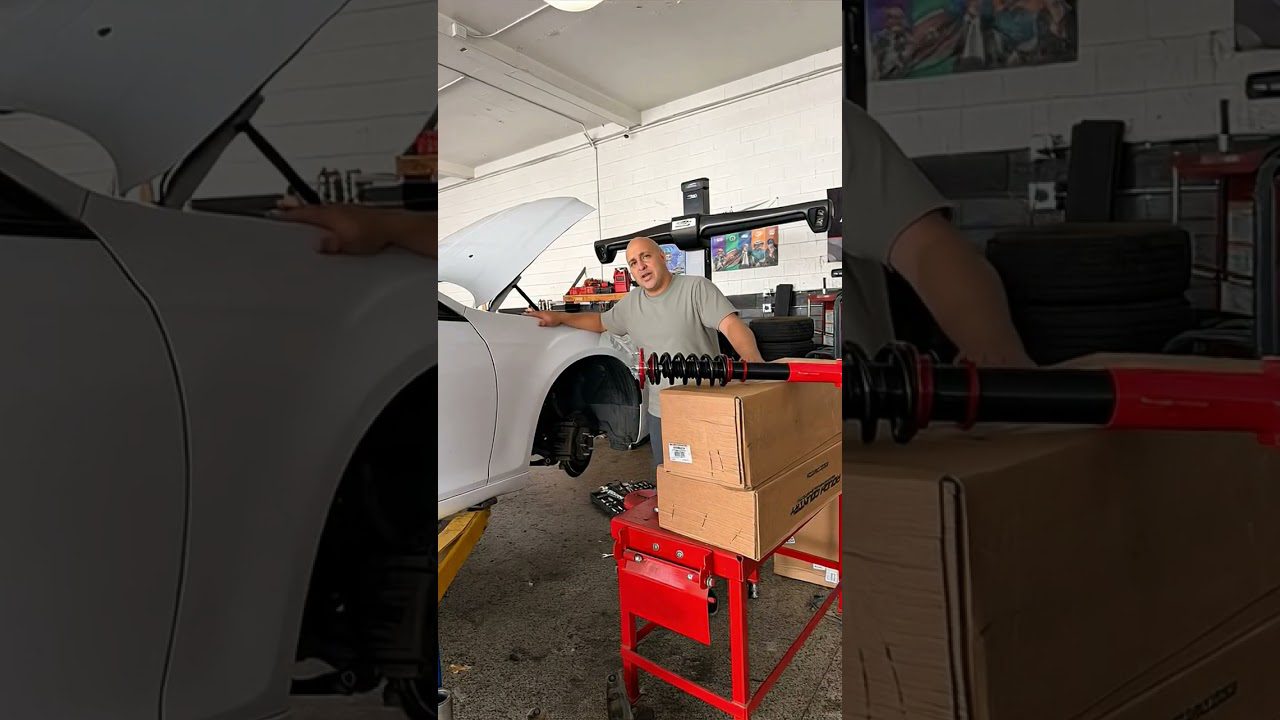
And right now there’s a good reason to stop putting it off: 10% off coilovers, with financing so you don’t pay until 2028. Watch the install in our short video first.
What is a coilover?
“Coilover” is short for coil-over-shock. It is a single suspension unit where a coil spring sits around (over) a shock absorber, also called a damper. The spring holds the weight of the car and absorbs bumps. The damper controls how fast the spring is allowed to compress and extend, so the car doesn’t keep bouncing after every bump.
Many cars already use a strut with a spring around it from the factory, so what makes an aftermarket coilover different? Adjustability. A factory strut has a fixed ride height, a fixed spring rate and fixed damping. A performance coilover lets you change some or all of these:
- Ride height: how high or low the car sits.
- Damping: how firm or soft the shock feels, usually through a knob on top of the shock.
- Spring rate: how stiff the spring is, by swapping springs.
- Camber and caster: on kits that include adjustable top mounts (camber plates).
That adjustability is the whole point. Instead of accepting one compromise chosen by the factory, you can set the car up for how you actually drive.
The parts of a coilover, explained
When you look at a coilover kit, here are the main components and what each one does.
Shock body (damper)
The shock body is the main tube that holds the oil and the piston. As the wheel moves, the piston pushes oil through small valves. The size of those valves and how they open determine the damping force. Higher quality dampers use more precise valving, which gives better control without making the ride harsh.
Coil spring
Aftermarket coilovers usually use straight, linear-rate springs measured in kg/mm or lbs/in. A spring rated at 8 kg/mm needs 8 kg of force to compress it 1 mm. Higher spring rates mean less body roll and less dive under braking, but also more of the road’s texture reaching the cabin. The right rate depends on the car’s weight, its weight distribution, and how it will be driven.
Helper and tender springs
When a car is lowered a lot, the main spring can become loose at full droop (when the wheel hangs down, like on a lift or over a big dip). A small helper or tender spring keeps the main spring seated so it doesn’t rattle or move out of place.
Spring perches and lower mount
Threaded collars on the shock body hold the spring and set its preload. On a full-body (or full-length) adjustable coilover, the lower mount also threads on the body, so you can change ride height without changing the spring preload. This is a big deal: it keeps the full suspension travel available even when the car is lowered. Cheaper “sleeve” style setups only move the spring perch, which lowers the car by reducing travel, and that usually means a bouncier, bottoming-out ride.
Top mounts
The top mount connects the coilover to the car’s body. Kits come with either rubber mounts (quieter, more comfortable) or pillow ball mounts (a spherical bearing that gives more precise steering feel but can transmit more noise). Many kits include adjustable camber plates up front so the alignment can be corrected after lowering.
Monotube vs. twin-tube coilovers
This is one of the most important technical differences between coilover kits.
- Monotube: a single tube with the oil and a high-pressure nitrogen gas chamber separated by a floating piston. Monotubes use a larger piston, cool more efficiently, and resist fading when they get hot during hard driving. Most performance coilovers are monotube designs.
- Twin-tube: an inner and outer tube, with oil moving between them. Twin-tubes are often a little more comfortable on rough roads and are less expensive to make, but they can fade sooner when worked hard.
Neither is “wrong”. For a daily driver that sees freeway miles and the occasional canyon run, a quality twin-tube or a softly valved monotube can be perfect. For track days and aggressive driving, monotube is usually the better choice.
Damping adjustment: 1-way, 2-way and 3-way
Most coilovers let you adjust damping with a knob on top of the shaft, often with 16, 30 or more “clicks”.
- Non-adjustable: the damping is fixed, matched to the springs by the manufacturer. Simple and often very well tuned.
- 1-way (single adjustable): one knob changes rebound and compression together. This is what most street coilovers use.
- 2-way: rebound and compression adjust separately, so you can control how quickly the car settles after a bump independently from how firmly it resists the bump.
- 3-way and beyond: separate high- and low-speed compression adjustment, mostly for dedicated race cars.
For most of our customers, a quality 1-way adjustable kit gives the best balance. You can set it softer for daily driving and firm it up for a weekend drive in a couple of minutes.
Coilovers vs. lowering springs vs. air suspension
Coilovers aren’t the only way to lower a car, so here’s how they compare.
Lowering springs
Lowering springs replace the factory springs but keep the factory shocks. They are the cheapest way to drop a car, but the drop is fixed, and the factory shocks were never designed for shorter, stiffer springs. That often shortens shock life and can make the ride bouncy. If you go this route, matched performance shocks are a smart addition.
Coilovers
Coilovers replace the spring and shock together as a matched system, with adjustable height and usually adjustable damping. They cost more than springs, but they give you control, and the parts are designed to work together.
Air suspension (air ride)
Air suspension uses air bags instead of coil springs, so ride height can be changed with a button, even all the way down when parked. It’s great for show cars and very low builds, but it costs considerably more, adds a compressor, tank and lines, and has more parts to maintain.
For most drivers who want a lower, better-handling car at a reasonable price, coilovers are the sweet spot.
The advantages of coilovers
- Adjustable ride height. Set the exact stance you want, keep the car level front to rear, and raise it later if you change wheels or need more clearance.
- Lower center of gravity. A lower car shifts less weight in corners, which means less body roll and more grip.
- Better handling and steering response. Stiffer springs and properly matched damping keep the tires flatter on the road, so the car turns in faster and feels more planted.
- Less brake dive and squat. The nose doesn’t dip as much when you brake hard, and the rear doesn’t squat as much when you accelerate.
- Tunable ride quality. Adjustable damping lets you choose comfort for the commute and firmness when you want it.
- Perfect wheel fitment. Close up the wheel gap and line the tire up with the fender for that clean, finished look.
- Alignment correction. Camber plates help bring alignment back into spec after lowering, which protects your tires.
- Rebuildable and long-lasting. Many quality coilovers can be rebuilt or revalved instead of replaced.
- Corner balancing. Because each corner is adjustable, a car can be corner balanced so weight is spread evenly, which is a real advantage for track use.
Things to consider before you buy
We’d rather you know the trade-offs up front than be surprised later.
- Ride comfort: coilovers are usually firmer than stock. Choosing sensible spring rates and not going too low makes a big difference.
- Clearance: a very low car has to be careful on steep driveways, speed bumps and parking blocks.
- Noise: pillow ball top mounts can transmit more noise than rubber mounts.
- Alignment: any ride height change requires an alignment afterward. Skipping it will wear out tires quickly.
- Legal and warranty: check local ride height rules, and ask about how a modification may affect your vehicle warranty.
- Quality matters: very cheap no-name coilovers can leak, rattle or fail early. A trusted brand and a proper install are worth it.
Popular coilover brands and what they’re known for
There are a lot of coilover brands, and the right one depends on your car, your budget and how you drive. Here are some of the best-known names and what sets each apart.
BC Racing
One of the most popular street coilovers. The BR series is a monotube, full-length adjustable design with 30 levels of damping adjustment, available for a huge range of vehicles. A strong value choice for daily drivers and enthusiasts.
KW Suspensions
A German brand known for premium quality and OEM-level engineering. The V1 has fixed damping, the V2 adds rebound adjustment, and the V3 has separate rebound and compression adjustment. KW is popular on European cars and higher-end builds.
ST Suspensions
Made by the same group as KW, ST offers a more affordable line such as the XA and XTA kits, with good quality at a lower price point.
Bilstein
A legendary German name in shocks and monotube damping. The B14 coilover is a comfortable, non-adjustable street setup, and the B16 adds damping adjustment. Bilstein is known for a great balance of comfort and control.
Tein
A Japanese brand with a long motorsport history. Kits like the Flex Z and Street Advance Z offer adjustable damping and height at a reasonable price, and Tein is especially popular on Japanese cars.
Öhlins
A Swedish brand at the top end of the market, famous in racing. The Road & Track line uses Öhlins’ Dual Flow Valve technology to keep the car controlled while staying surprisingly comfortable on the street.
Fox and King (trucks and off-road)
Coilovers aren’t just for lowering. On trucks, Jeeps, UTVs and off-road builds, coilovers from brands like Fox and King are used to add lift, travel and heat-resistant damping for rough terrain. Bilstein’s 6112 front coilover is also a popular truck option. See our off-road upgrades for more.
Not sure which brand fits your car? That’s what we’re here for. Tell us your vehicle, your goals and your budget, and our team will engineer the right setup for you. Premium kits are easier on the wallet with our financing too.
Why Riverside drivers choose our engineering team
Anyone can bolt on a set of coilovers. Getting a car to sit right, ride well and handle better takes engineering. That’s the standard we hold ourselves to on every vehicle that comes through our doors.
- Engineering first, parts second. We start with how your car is built and how you drive it, then choose the kit, spring rates and setup to match. We’ll tell you honestly if a cheaper option is the better fit.
- Trained, certified-minded technicians. We’re so serious about installation standards that we host MECP training workshops right here at our shop, and that same discipline goes into every suspension job.
- Complete in-house setup. Install, ride height, damping and alignment are all done under one roof, so nothing is left half-finished.
- One shop for the whole build. Suspension, wheels and tires, brakes, lighting, tint and audio, planned together so everything works as one system.
- Flexible payment. With our financing and leasing options and no credit check programs, the right parts don’t have to wait.
- Open 7 days a week. We fit your schedule, not the other way around.
How we install coilovers at Advanced Car Stereo Riverside
A coilover is only as good as its installation and setup. Here’s our process.
- Consultation. We talk about how you drive, how low you want to go, your wheel and tire setup, and your budget, then recommend a kit and spring rates that fit.
- Inspection. We check the car’s bushings, ball joints, end links and other suspension parts. Worn parts should be replaced while everything is apart.
- Removal. The factory struts and springs are removed safely with the right tools.
- Pre-set and install. We pre-set the coilovers to a starting ride height and preload, then install them with the correct hardware and torque specs.
- Ride height and level. Once the car is back on the ground and settled, we fine-tune the height so it sits evenly side to side and the front-to-rear rake looks right.
- Damping setup. We set the damping to a good starting point for your driving and show you how to adjust it.
- Alignment. Every coilover install needs an alignment. We set camber, caster and toe so the car tracks straight and the tires wear evenly.
- Road test and recheck. We drive the car, listen for noises, and recheck everything before you pick it up.
We also recommend rechecking ride height and hardware after the first few hundred miles, as springs settle. Just stop by and we’ll take a look.
How to care for your coilovers
- Clean the threaded body occasionally, especially after rain, and apply an anti-seize or the manufacturer’s recommended protectant so the collars don’t seize.
- Check for oil leaks around the shaft seal at your regular service.
- Listen for new clunks or rattles, which can mean a loose collar or worn top mount.
- Get an alignment check if you hit a big pothole or curb, or if you change ride height.
Frequently asked questions
Will coilovers make my ride too stiff?
Not if they’re chosen and set up correctly. With sensible spring rates, a moderate drop and the damping set softer, many cars ride very well on coilovers, and often feel more controlled than stock.
How low can I go?
It depends on your car, wheels and tires. Most daily drivers are happiest with a moderate drop that keeps enough suspension travel and clearance. We’ll help you find the right balance.
Do I need an alignment after installing coilovers?
Yes, always. Changing ride height changes camber and toe, and skipping the alignment can wear out tires very quickly.
How long does installation take?
Most installs, including the alignment, can be done in a day. Call us and we’ll give you an estimate for your vehicle.
Can I adjust them myself later?
Damping adjustment is usually as easy as turning a knob. Ride height changes need the right tools and an alignment afterward, so we recommend letting us handle those.
Can I finance my coilovers?
Yes. We offer financing and leasing options, including programs with no credit check. Ask us about current offers.
The deal: 10% off coilovers + no payments until 2028
For a limited time, we’re taking 10% off coilover kits. Pair it with our financing and you can get your car lowered and dialed in today and not pay until 2028. See our financing and leasing options or ask about our no credit check programs.
Financing subject to approval. Ask in store for full terms and details.
While your car is here, we can also take care of wheels and tires, brakes, tint, lighting, and of course audio.
Visit Advanced Car Stereo Riverside
📍 10555 Magnolia Ave, Riverside, CA 92505
📞 (951) 358-0516
🕘 Open 7 days, 9am to 6pm
Ready to lower your ride the right way? Call us or stop by today to lock in 10% off coilovers.
Watch the video: Lower your ride with 10% off coilovers
Finance your upgrade with no credit check
Get the upgrade you want today and pay over time. Apply for our No Credit Check financing, or see all of our financing and leasing options. Financing is subject to approval; ask in store for details.


