

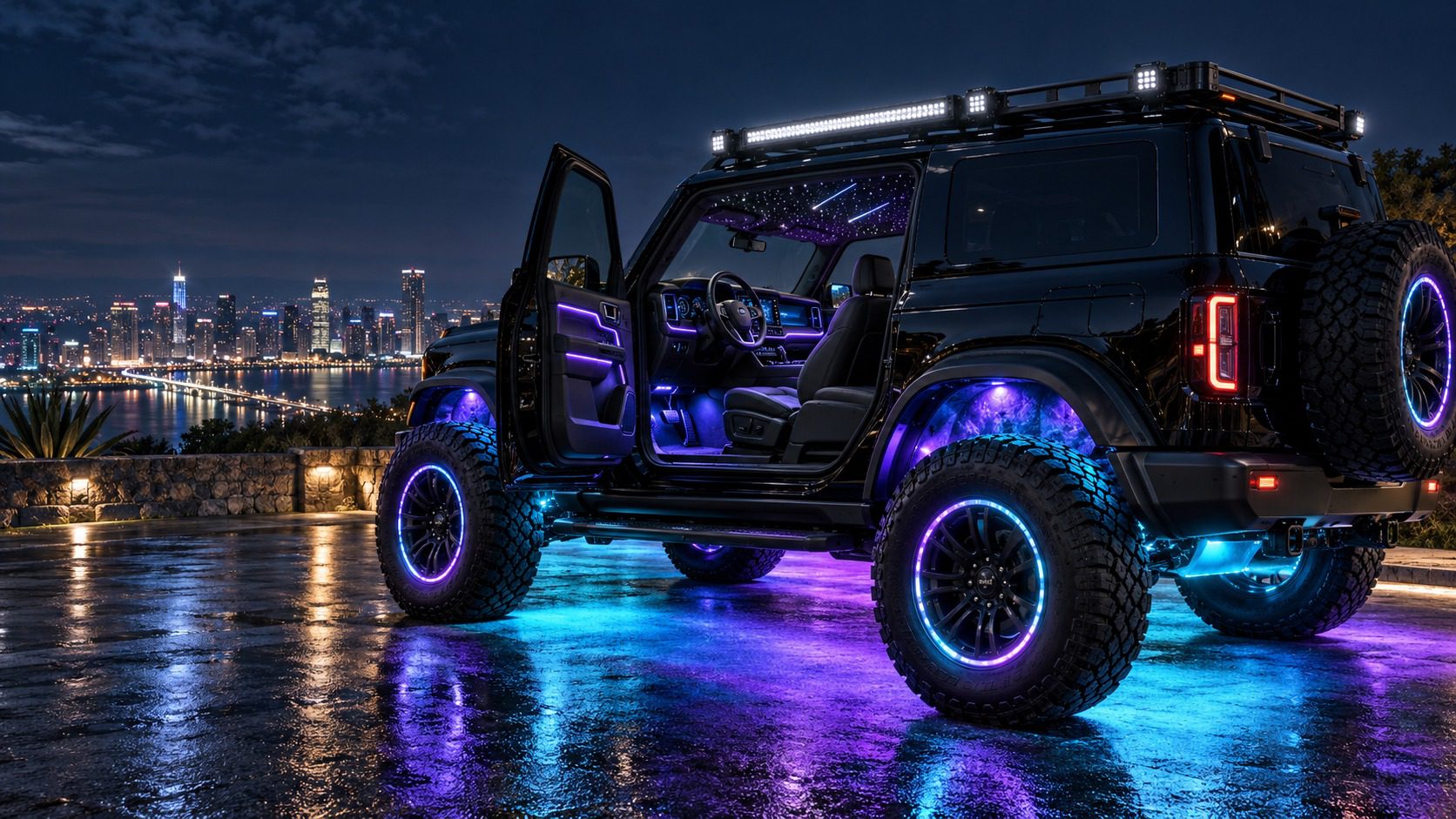
Transform Your Ride With Custom Automotive Lighting in Riverside
Your vehicle should feel like your own the moment you open the door. Custom automotive lighting can completely change that experience. A refined ambient lighting system can make a factory interior feel more luxurious. A custom starlight headliner can create a private night sky above the seats. Shooting stars can bring movement and excitement to the headliner. Underglow, rock lights, wheel lights, and rack lighting can give a truck, Jeep, SUV, or show car an unmistakable nighttime presence.
At Advanced Car Stereo in Riverside, California, we design and install complete custom vehicle lighting systems for drivers who want more than a basic LED strip. Our team can build subtle OEM-style interior lighting, bold color-changing exterior lighting, detailed starlight headliners, functional off-road illumination, or a synchronized package that brings the entire vehicle together.
Every vehicle and every customer is different. That is why the best lighting installation starts with a design conversation. We look at your vehicle, your preferred style, how you use it, and what you want to control. Then we recommend the right locations, number of lights, colors, materials, controllers, wiring, protection, and installation approach.
Whether you drive a daily commuter, luxury sedan, sports car, Tesla, pickup, Jeep, SUV, Sprinter van, off-road vehicle, motorcycle, UTV, or custom show build, Advanced Car Stereo can help you create a lighting system that looks intentional—not like an afterthought.
Why Custom Car Lighting Has Become So Popular
Automotive lighting is one of the most noticeable upgrades you can make without changing the basic shape of your vehicle. During the day, a properly installed system can remain discreet. At night, the same vehicle can take on a completely different personality.
Drivers choose custom lighting for many reasons:
- To create a luxury interior atmosphere
- To personalize a new or used vehicle
- To match a car-audio, upholstery, wrap, tint, wheel, or suspension build
- To improve visibility around an off-road truck or Jeep
- To highlight wheels, suspension, steps, or body lines
- To build a show-car presentation
- To add useful bed, cargo, rack, or work lighting
- To create coordinated lighting for social media, events, and car meets
- To upgrade a basic factory interior with modern color and control
The biggest difference between a quality system and a disappointing one is not simply the number of LEDs. Good results depend on placement, diffusion, brightness balance, wiring, controller quality, mounting, color consistency, and the installer’s attention to detail.
Interior Ambient Lighting: Give Your Cabin a Luxury Look
Interior ambient lighting adds controlled illumination to selected areas of the cabin. It can be calm and elegant, bold and colorful, or somewhere in between. The goal is to make the lighting look like it belongs in the vehicle.
Popular ambient-lighting locations include:
- Door-panel accent lines
- Dashboard trim
- Center console
- Front and rear footwells
- Door pockets
- Cupholders
- Speaker grilles
- Under-seat areas
- Door handles
- Storage compartments
- Air vents on compatible custom builds
Customers can choose a clean single-color design, RGB multicolor lighting, or RGBW systems that add a dedicated white channel. Depending on the equipment, lighting may be controlled by a mobile app, handheld remote, installed switch, or dedicated controller. Available functions may include color selection, brightness adjustment, smooth fades, chasing patterns, music-reactive modes, and saved scenes.
OEM-Style Ambient Lighting Versus Basic LED Strips
There is a major visual difference between exposed LED strips and an integrated ambient lighting system. OEM-style lighting uses careful placement and diffusion so the driver sees a smooth line or glow instead of individual LED dots. Wires, modules, and connections should remain hidden. The lighting should complement the dashboard and door design rather than overpower it.
For customers who prefer a sophisticated appearance, we often recommend balanced brightness and coordinated zones. A soft blue, red, amber, purple, or white accent can transform the cabin without distracting the driver. For a more dramatic build, additional zones, animated effects, illuminated speaker areas, or synchronized colors can be added.
The best solution depends on the construction of the vehicle’s trim. Some vehicles allow highly integrated lighting, while others require a different approach to achieve a clean result. Our team inspects the interior before recommending a package.
Starlight Headliners: Bring the Night Sky Into Your Vehicle
A starlight headliner uses individual fiber-optic strands to create illuminated stars across the vehicle’s ceiling. Each fiber is routed through the headliner and trimmed carefully at the surface. When the light source is activated, the ceiling comes alive with hundreds or even thousands of points of light.
This upgrade is often associated with ultra-luxury vehicles, but a custom starlight ceiling can be installed in many cars, trucks, SUVs, and vans. The design can be understated and elegant or dense and dramatic.
Common starlight headliner options include:
- Different star counts based on headliner size and desired density
- Single-color or multicolor illumination
- Adjustable brightness
- Twinkle effects
- App or remote control
- Custom star patterns
- Constellations
- Initials, names, logos, or meaningful shapes when practical
- Suede or premium headliner material upgrades
- Matching pillars and trim
- Shooting-star effects
- Coordinated ambient lighting
How Many Stars Should You Choose?
There is no universal number that works for every vehicle. A compact car has a smaller usable headliner than a full-size SUV, pickup, or Sprinter. Panoramic sunroofs also reduce the surface area available for fiber optics.
A lower star count produces a cleaner, more open night-sky effect. A higher count creates a brighter, denser galaxy. The right number depends on the headliner dimensions, sunroof configuration, desired pattern, budget, and how much visual impact the customer wants.
Star distribution matters as much as quantity. Random spacing, multiple fiber sizes, controlled clusters, and thoughtful negative space can make the result look natural. If every point is the same size and evenly spaced in a grid, the ceiling may look artificial. Our goal is a hand-crafted pattern with depth and balance.
Starlight Headliners With Suede
Many customers pair their fiber-optic installation with a suede-style headliner. The darker, softer surface provides a premium finish during the day and creates excellent contrast at night. Black is popular, but the best material and color depend on the interior.
Replacing headliner material requires proper preparation and upholstery technique. The new covering must conform around contours, openings, visors, overhead consoles, grab handles, and trim pieces. A beautiful starlight effect should be matched by a clean daytime finish.
Shooting Stars: Add Motion to the Headliner
Shooting stars are one of the most exciting upgrades available for a starlight headliner. Instead of remaining as stationary points, selected fiber-optic sections illuminate in sequence to create the appearance of light traveling across the roof.
The effect can be subtle and occasional or more energetic and frequent, depending on the controller and design. Shooting stars work best when they are positioned intentionally within the main star field. Direction, length, spacing, and brightness all influence the final result.
Popular shooting-star options may include:
- One or several shooting-star paths
- Different path lengths
- Randomized timing
- Adjustable speed
- Coordinated colors
- Integration with the main twinkle effect
- Custom placement around sunroofs or overhead consoles
Shooting stars require additional planning, equipment, and labor. The fiber groups must be organized correctly behind the headliner and connected to the proper light engine. A rushed installation can look repetitive or poorly balanced. A carefully designed system creates a convincing moment that catches attention without ruining the luxury feel.
Panoramic Roof and Sunroof Lighting Options
Vehicles with a panoramic glass roof require a customized plan. Fiber optics cannot be placed through the glass itself, but that does not mean the vehicle cannot receive a dramatic ceiling treatment.
Depending on the vehicle, possible solutions may include:
- Starlights in the remaining upholstered headliner areas
- Ambient lighting around the panoramic roof opening
- Illuminated perimeter trim
- Stars installed in the sunshade when its construction allows
- Matching pillar lighting
- Door and dashboard ambient lighting that coordinates with the roof
Before promising a specific design, we inspect how the sunshade moves, where the airbags and roof components are located, and how much usable material remains. The final plan must respect the vehicle’s operation and safety systems.
LED Underglow: Make Your Vehicle Stand Out at Night
LED underglow places lighting beneath the vehicle to illuminate the ground and emphasize the vehicle’s shape. It can create a clean, floating appearance or a bold color-changing effect.
Underglow systems may be installed using flexible strips, rigid bars, pods, or vehicle-specific combinations. Available options can include:
- Single-color lighting
- RGB multicolor lighting
- RGBW with a dedicated white channel
- Chasing or flowing effects
- Multiple lighting zones
- App and remote control
- Installed master switch
- Music-reactive modes
- Side, front, and rear coverage
- Integration with rock lights or wheel lights
The correct system depends on the vehicle’s underbody, ground clearance, exhaust routing, heat sources, lift points, suspension travel, and exposure to water and debris.
What Is Zero-Shadow Underglow?
Customers often ask for zero-shadow lighting. Traditional underglow or rock-light systems can create bright hotspots directly under each light, with dark gaps between them. A zero-shadow design aims for a smoother, more continuous glow across the ground.
Achieving that look may require longer frame-mounted light strips, closer fixture spacing, additional pods, wheel-well lighting, or a combination of products. Mounting angle is critical. The light must spread outward and overlap with adjacent zones instead of pointing into a narrow area.
No installation can literally eliminate every shadow created by suspension, exhaust, tires, and chassis components. However, a carefully designed system can greatly reduce dark spots and produce much more even coverage. We plan the layout around the actual vehicle instead of assuming one universal kit will look the same on every car or truck.
For a premium zero-shadow appearance, we may recommend:
- Continuous frame-rail lighting
- Front and rear cross-lighting
- Additional rock lights near dark zones
- Wheel-well or wheel-ring illumination
- Proper diffusion and beam overlap
- Separate brightness control for different zones
Rock Lights for Trucks, Jeeps, SUVs and Off-Road Vehicles
Rock lights are compact, durable LED fixtures mounted under the vehicle, inside wheel wells, along frame rails, or near suspension components. They began as functional off-road lights that helped drivers see rocks and obstacles around the tires. Today, they are also popular for custom trucks, Jeeps, SUVs, UTVs, and show vehicles.
Rock-light options can include:
- Pure white functional lighting
- Amber lighting
- RGB color-changing lights
- RGBW systems with stronger white output
- Different pod counts
- Wheel-well-only layouts
- Full underbody coverage
- Bluetooth or app control
- Dedicated switches
- Scene-lighting zones
- Integration with underglow and wheel lights
A basic four-pod system may illuminate the wheel wells, but a full-size lifted truck often needs more fixtures for balanced coverage. Eight, twelve, sixteen, or more lights may be appropriate depending on the wheelbase, lift, underbody layout, desired brightness, and whether the goal is trail visibility or show presentation.
Rock Lights Versus Underglow
Rock lights and underglow can create similar visual effects, but they are not identical.
Rock lights use individual fixtures. They are useful for targeted illumination, wheel wells, suspension components, and harsh environments. Underglow strips or bars provide longer lines of light and can create smoother coverage along the sides of the vehicle.
For the strongest result, many customers combine the two. Frame lighting fills the long areas, while rock lights cover the wheels, corners, front, rear, and chassis areas that would otherwise remain dark.
Wheel Lights and Wheel-Ring Lighting
Wheel lights place illumination inside or behind the wheel so the rim, brake area, and wheel opening glow at night. They are especially popular on trucks, performance cars, luxury vehicles, and show builds.
Options can include:
- Single-row or multi-row wheel rings
- RGB or RGBW illumination
- Pure white wheel lights
- Flowing and chasing patterns
- Brake-triggered or turn-signal integration when supported and legally appropriate
- App-controlled colors and scenes
- Coordinated lighting with underglow and rock lights
Wheel-light installation requires careful attention to moving and heated components. Wiring must be protected from the tire, axle, suspension, steering movement, brake components, and road debris. Mounting brackets must be secure and positioned for clearance. This is an area where professional installation is especially valuable.
Rack Lights, Roof Lights and Bed-Rack Lighting
For trucks, Jeeps, SUVs, overland vehicles, work vehicles, and UTVs, rack lighting can add useful illumination as well as an aggressive off-road appearance.
Rack-lighting options include:
- Roof-rack LED light bars
- Bed-rack forward or rear-facing lights
- Side-facing scene lights
- Compact LED pods
- Cargo-area lights
- Chase lights
- Work lights
- Camp lights
- Rock lights mounted beneath the rack
- White and amber combinations
Forward-facing light bars can provide long-distance or wide-area lighting for off-road use. Side and rear scene lights can help at a campsite, jobsite, or dark trail. Bed-rack lighting can illuminate tools, cargo, motorcycles, or camping equipment.
The wiring should include appropriate fusing, relays or power-control modules, correctly rated switches, weather-resistant connections, and clean routing. Light placement must also account for wind noise, glare on the hood, reflections from the windshield, and local laws governing on-road use.
More Custom Automotive Lighting Options
Advanced Car Stereo can help customers create a complete lighting theme rather than installing one isolated product. Depending on the vehicle and project, available options may include:
- Illuminated speaker grilles
- LED door sills
- Door-pocket lighting
- Footwell lighting
- Cupholder lighting
- Trunk and cargo lighting
- Engine-bay lighting
- Grille lighting
- Bed lighting
- Chase lights
- Wheel-well lighting
- Wheel rings
- Headliner stars in door panels
- Motorcycle accent lighting
- Marine and UTV lighting
- Custom switches and control panels
- RGB, RGBW, white, or amber lighting
- Music synchronization
- App-controlled scenes
- Zone control
Some customers want every lighting zone to match. Others prefer separate controls—for example, subtle interior ambient lighting for daily driving, bright white rock lights for off-road use, and color-changing underglow for shows. We can discuss how the zones should operate before the installation begins.
Why Professional Lighting Installation Is Worth It
An inexpensive light kit can become expensive if poor installation damages the vehicle, drains the battery, creates electrical problems, interferes with airbags, or fails after the first rain.
A professional installation should consider:
- Proper circuit protection and fuse sizing
- Safe current load
- Relays or power modules when required
- Battery protection
- Heat and exhaust clearance
- Waterproof connections
- Cable abrasion and road-debris protection
- Steering and suspension movement
- Tire clearance
- Airbag and interior-trim safety
- Service access
- Controller ventilation and accessibility
- Secure mounting
- Clean, hidden wiring
- Reliable grounding
The visual design is equally important. Brightness should be balanced from side to side. Colors should match across zones. Light sources should be hidden where possible. There should not be loose wires, exposed adhesive, uneven star spacing, obvious LED dots, or random dark sections.
Why Choose Advanced Car Stereo in Riverside?
Advanced Car Stereo is more than a place to buy an LED kit. We are a one-stop automotive customization shop serving Riverside and surrounding Inland Empire communities. Our team can plan lighting as part of the entire vehicle instead of treating it as a separate accessory.
Here are the advantages of working with us:
1. Complete Customization Under One Roof
We work with car audio, Apple CarPlay and multimedia, alarms, cameras, window tint, vinyl wraps, paint protection film, ceramic coating, wheels, tires, suspension, upholstery, star headliners, and custom lighting. If your lighting needs to coordinate with a suede headliner, audio build, wrap color, wheel package, or truck setup, our team can plan the complete look.
2. Designs Built Around Your Vehicle
Different vehicles require different solutions. A Tesla with a panoramic roof, a lifted RAM truck, a Jeep Wrangler, a luxury sedan, and a Sprinter van should not receive the same lighting layout. We inspect the available space, trim, wiring routes, underbody, and intended use before recommending the system.
3. Clean, Professional Installation
The best custom lighting should look impressive at night and clean during the day. We focus on hidden wiring, secure mounting, balanced placement, proper protection, and convenient controls.
4. Multiple Lighting Levels and Options
Customers do not all want the same result or budget. We can discuss entry-level upgrades, premium OEM-style ambient lighting, dense starlight headliners, shooting-star upgrades, off-road lighting, zero-shadow underglow concepts, and complete synchronized show packages.
5. Experience With Complete Vehicle Builds
Lighting often interacts with upholstery, audio equipment, trim panels, suspension, wheels, exterior styling, and vehicle electronics. Working with a shop that understands the entire build helps create a more cohesive finished vehicle.
6. Local Riverside Service
Customers can visit our Riverside location, review options in person, discuss their design with our team, and bring the vehicle back to the same shop for future additions or adjustments. We serve drivers from Riverside, Corona, Moreno Valley, Eastvale, Norco, Jurupa Valley, Perris, and surrounding areas.
How to Plan Your Custom Lighting Package
Before requesting a quote, think about the following questions:
- What is the year, make, and model of your vehicle?
- Do you want interior, exterior, or complete lighting?
- Do you prefer a luxury OEM-style look or a bold show-car effect?
- Do you want single-color, RGB, or RGBW lighting?
- Do you need app, remote, switch, or multi-zone control?
- How many starlights or shooting-star paths do you want?
- Does the vehicle have a standard roof, sunroof, or panoramic glass roof?
- For trucks and off-road vehicles, do you need functional white light, color effects, or both?
- Do you want the system coordinated with audio, upholstery, wheels, wrap, or tint?
- What is your target budget and desired completion date?
Photos of the vehicle and examples of the style you like can help the design process. Final pricing depends on the vehicle, equipment, material, number of lighting zones, installation difficulty, controller, custom fabrication, and labor.
Frequently Asked Questions About Custom Car Lighting
Can ambient lighting be installed in any car?
Ambient lighting can be added to many vehicles, but the exact design and level of integration depend on the door panels, dashboard, center console, airbags, factory trim, and available wiring routes.
How long does a starlight headliner installation take?
Timing depends on the vehicle, star count, headliner material, shooting-star design, sunroof configuration, and other custom work. A quality starlight installation requires removing and reinstalling interior components carefully, placing each fiber, organizing the system, testing the effects, and finishing the headliner cleanly.
Can shooting stars be added to an existing starlight headliner?
Sometimes, but it depends on the existing kit, controller, light engine, fiber routing, and headliner condition. In many cases the headliner must be removed again, so it is usually more efficient to plan shooting stars during the original installation.
What is the difference between RGB and RGBW lighting?
RGB uses red, green, and blue LEDs to produce many colors. RGBW adds a dedicated white channel, which can provide a cleaner or brighter white than mixing RGB colors. Product quality and controller design also affect the final output.
Can underglow and rock lights use the same controller?
Some compatible systems can be synchronized, while others require separate controllers. We recommend choosing equipment with compatible voltage, wiring, color technology, communication method, and load capacity.
Will custom lights drain my battery?
Any lighting system consumes power. The actual draw depends on the number of lights, brightness, controller, and operating time. Proper wiring, switching, power management, and responsible use reduce the risk of battery drain.
Are underglow, wheel lights, and rock lights legal on the street?
Vehicle-lighting laws vary by state and situation. Certain colors, flashing patterns, brightness levels, mounting locations, and use while driving may be restricted. Exterior accent and off-road lights should be used responsibly, and customers should verify current California and local requirements. Installation does not guarantee that every color or mode is legal for public-road use.
Can the lights react to music?
Many controllers offer music-reactive modes. The quality of the effect depends on the controller and system configuration. For daily driving, smooth static colors or low-key animations may be less distracting.
Can you create a zero-shadow underglow look?
We can design for smoother, more complete ground coverage by combining frame strips, pods, rock lights, wheel-well lighting, and overlapping beam patterns. Vehicle components will always create some obstruction, but strategic placement can greatly reduce dark zones and hotspots.
Schedule Custom Car Lighting Installation in Riverside, CA
Your vehicle does not have to look like every other car on the road. With the right combination of ambient interior lighting, a custom starlight headliner, shooting stars, underglow, rock lights, wheel lighting, and rack lights, you can create a build that matches your personality and your vehicle.
Visit Advanced Car Stereo at 10555 Magnolia Avenue in Riverside, California, to discuss your custom automotive lighting project. Bring your vehicle information, ideas, inspiration photos, and desired budget. Our team will help you compare the options and create a professional plan.
From an elegant interior glow to a complete color-changing show build, Advanced Car Stereo is ready to transform your ride.
Your ride. Your style. One stop shop.


