

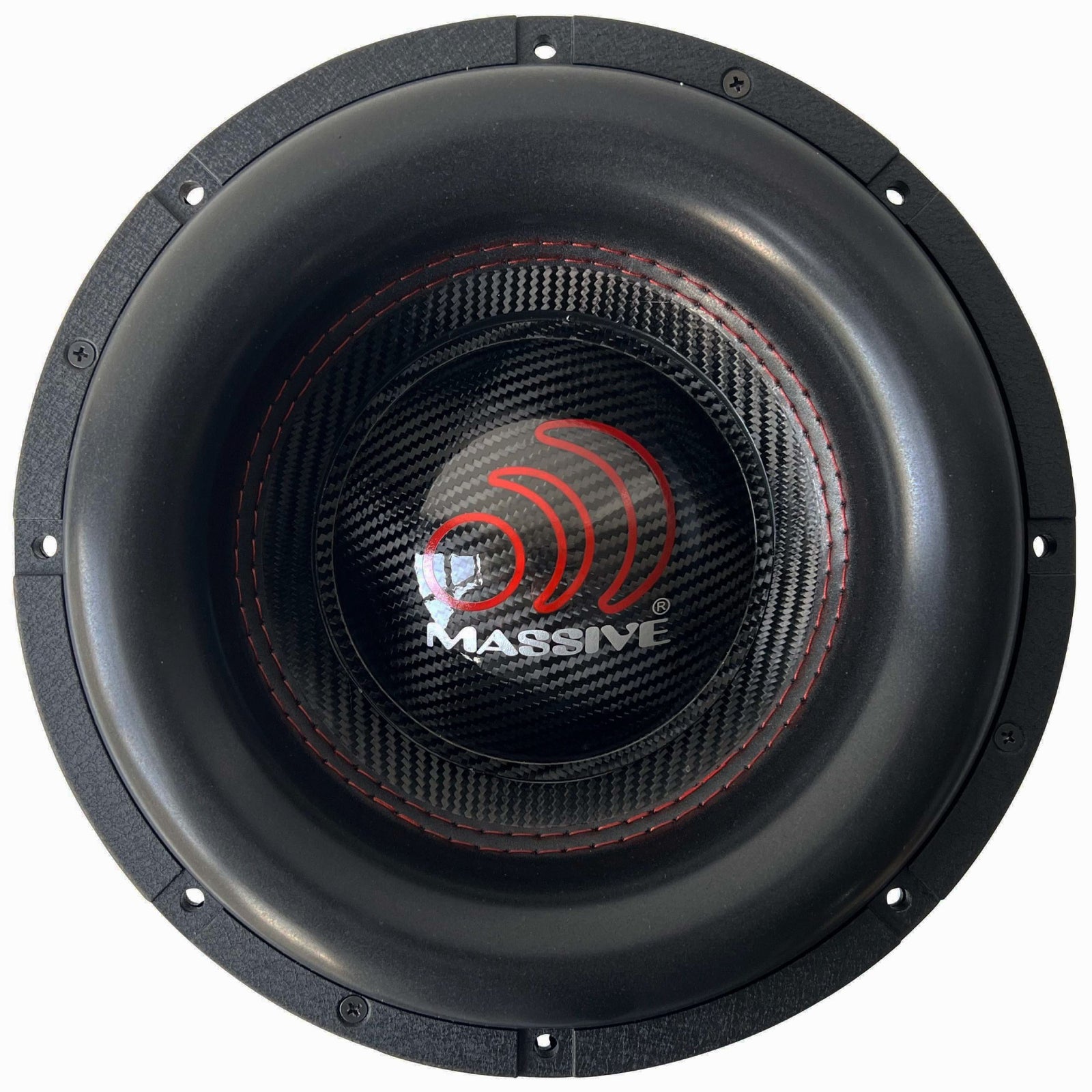
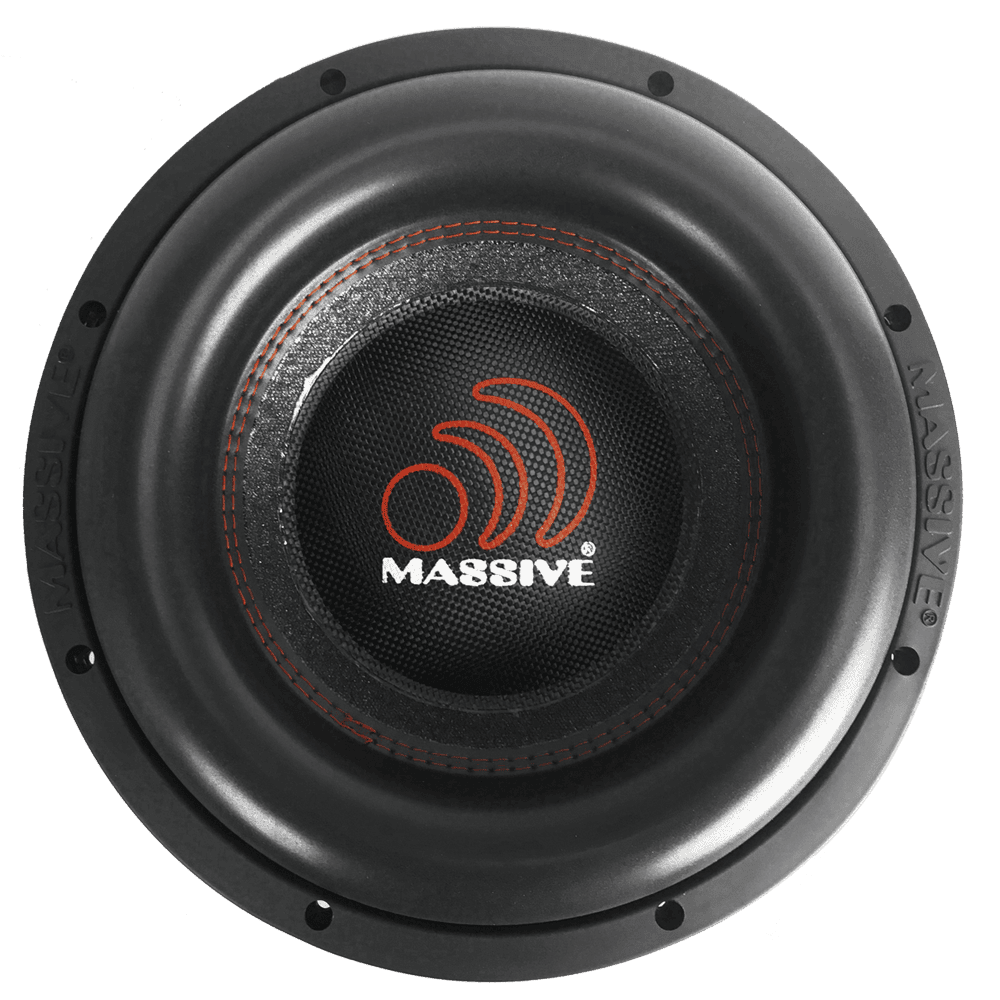
The Massive Audio BOA 12 inch subwoofer is the 12 our Riverside, CA installers recommend when a customer wants a serious SPL system. The 12″ is the size most of our customers start with, and the BOA 12″ is about as far as a 12 goes: 8,000 watts RMS, a 4″ voice coil, a 1,000 oz quad-stacked strontium motor and 48 mm of listed X-Max. It comes in two versions, the BOA121R (dual 1 ohm) and the BOA122R (dual 2 ohm). Below we explain each spec from a technical point of view, compare them with the older BOA 12s, and show how we would box, power and wire them.
Also in this series: the BOA 10″ (BOA102R) and the BOA 15″ (BOA151R / BOA152R).
BOA121R vs BOA122R specifications
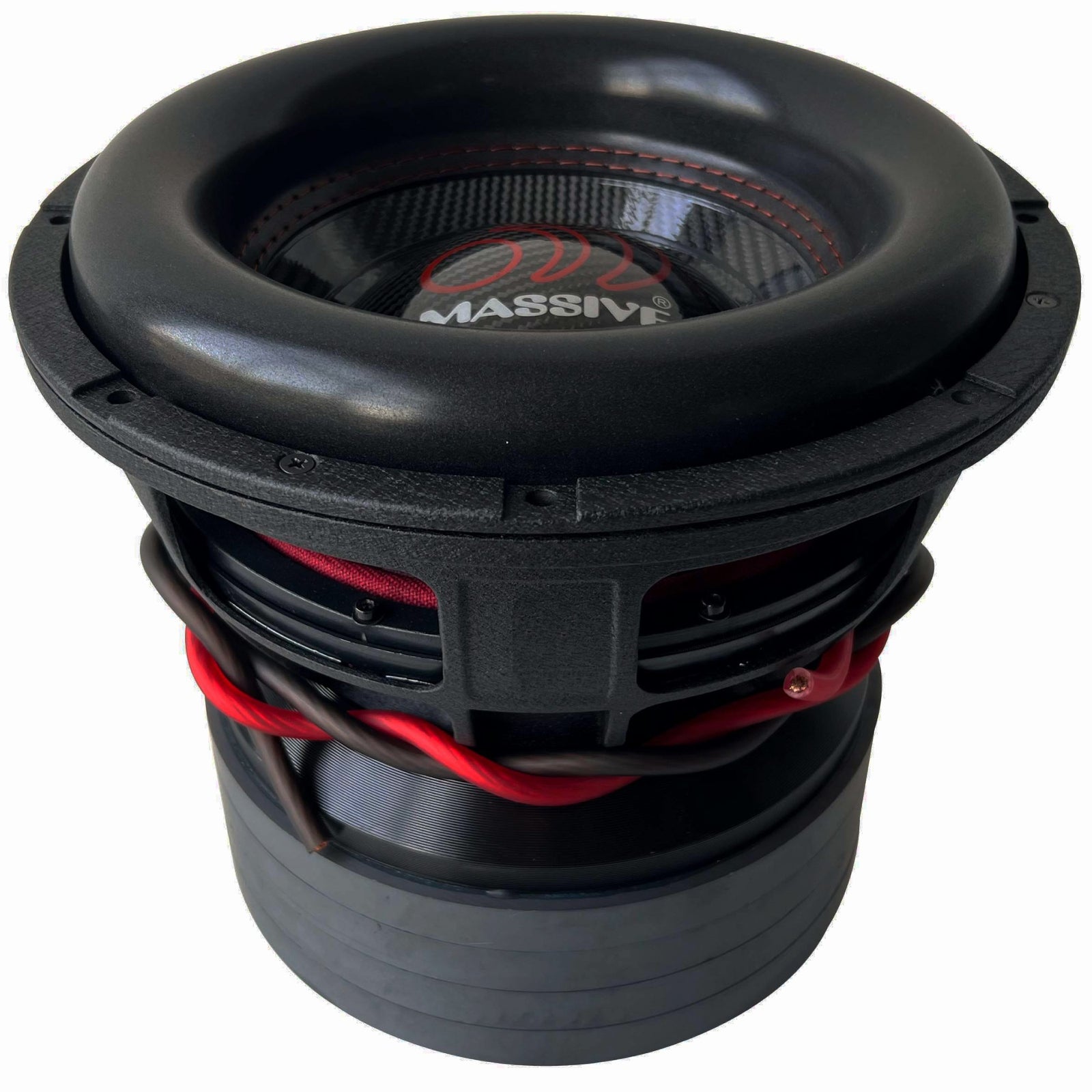
| Spec (Massive Audio published) | BOA121R | BOA122R |
|---|---|---|
| Size | 12″ | 12″ |
| Power, RMS / peak | 8,000 W / 16,000 W | 8,000 W / 16,000 W |
| Voice coil | 4″ flat copper-clad aluminum, dual 1 Ω | 4″ flat copper-clad aluminum, dual 2 Ω |
| Former | Black anodized, Kevlar spunlace | Black anodized, Kevlar spunlace |
| Magnet | 1,000 oz quad-stacked strontium | 1,000 oz quad-stacked strontium |
| Cone (spec table) | Carbon fiber with top layer shielded | Carbon fiber with top layer shielded |
| Surround | Wide multi-layer EROM foam | Wide multi-layer EROM foam |
| Basket | Die-cast aluminum | Die-cast aluminum |
| Leads | 8 AWG pure copper direct input | 8 AWG pure copper direct input |
| X-Max (2-Way) | 48 mm | 48 mm |
| SPL (2.83 V / 1 m) | 90 dB | 90 dB |
| Ported box | “Custom” | “Custom” |
| Sealed box | Not published | Not published |
| Weight | ~150 lb (description) | ~150 lb (description) |
| T/S parameters, mounting depth, cutout | Not published | Not published |
A note on Massive’s listings: the BOA121R page has a feature bullet that says “Dual 2 Ohm Impedance”, but its spec table, title and description all say dual 1 ohm. We go by the spec table: BOA121R = dual 1 ohm, BOA122R = dual 2 ohm. The BOA122R web address also mentions 132 pounds while its description says 150 pounds. If the exact weight matters for your build, we weigh the unit in the shop.
What “X-Max (2-Way) 48 mm” means
Xmax is how far the cone can move while the coil still sits in the motor’s usable field. Massive Audio lists 48 mm and labels it “2-Way”, but does not define the term. Our reading is that it is the total travel, in plus out. That works out to about 24 mm each way, which is still very long throw for a car subwoofer. For comparison, the older BOA models were rated at 25 mm (strontium) and 13 mm (neodymium) on the same “2-Way” label.
About the 90 dB rating
Massive lists 90 dB as “efficiency SPL @ 2.83 V / 1 m”. That is a voltage-based number: 2.83 volts is 1 watt into 8 ohms, but into a 1 ohm load the same 2.83 volts is 8 watts. Massive does not say how the coils were wired for the test, so treat it as a rough figure for comparing BOAs to each other, not to 4 ohm home speakers.
What Massive Audio does not publish
There are no Thiele/Small parameters (Fs, Qts, Qes, Qms, Vas, Re, Le, BL, Sd, Mms, Cms) on the BOA product pages, and no frequency response, mounting depth, cutout diameter or displacement. Without T/S numbers nobody can model a box for these subs on a computer with real accuracy. Anyone quoting exact Qts or Vas figures for the BOA R series is guessing. That is the main reason we build BOA enclosures to order, measure the actual driver, and tune by ear and meter in the vehicle.
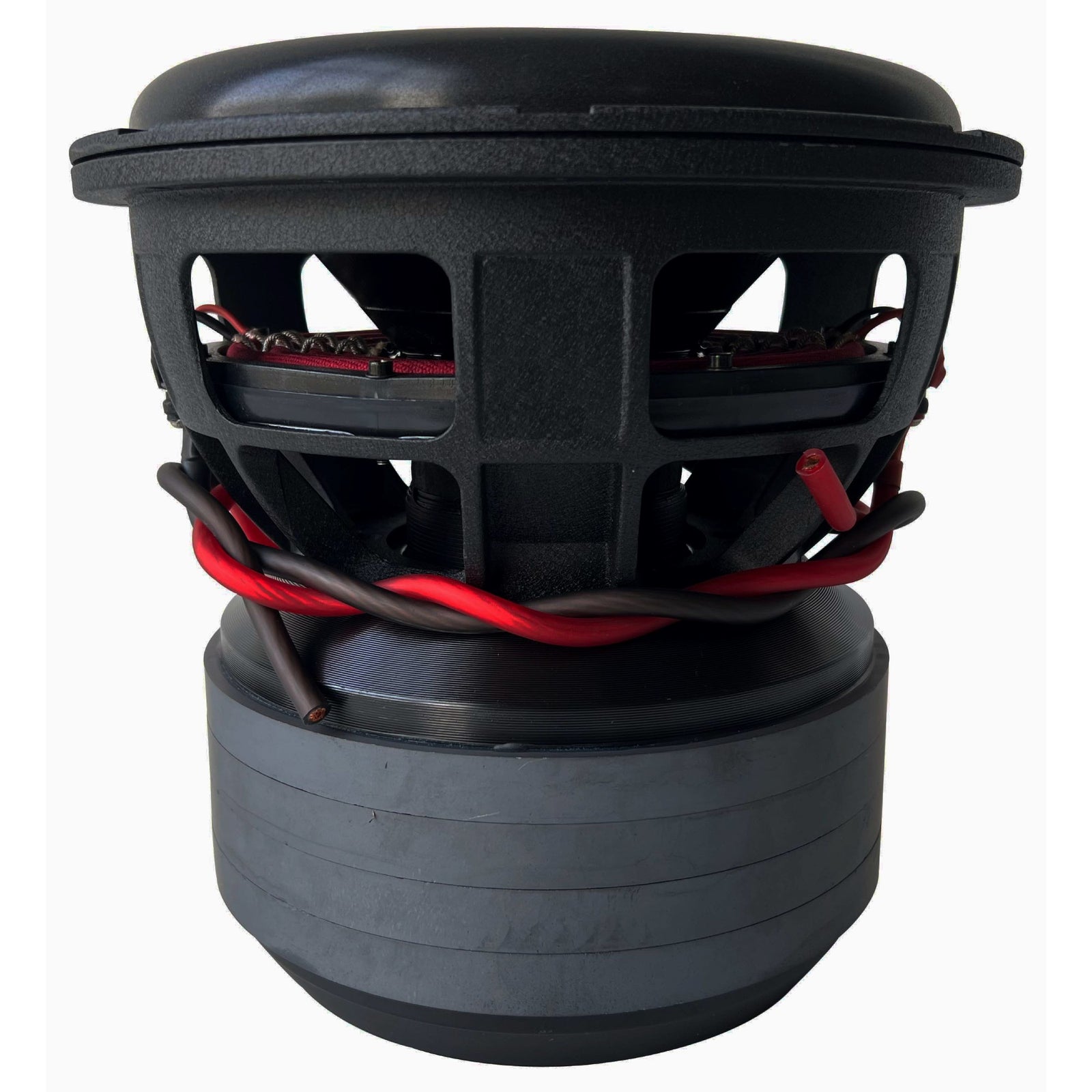
The motor: 1,000 oz of quad-stacked strontium
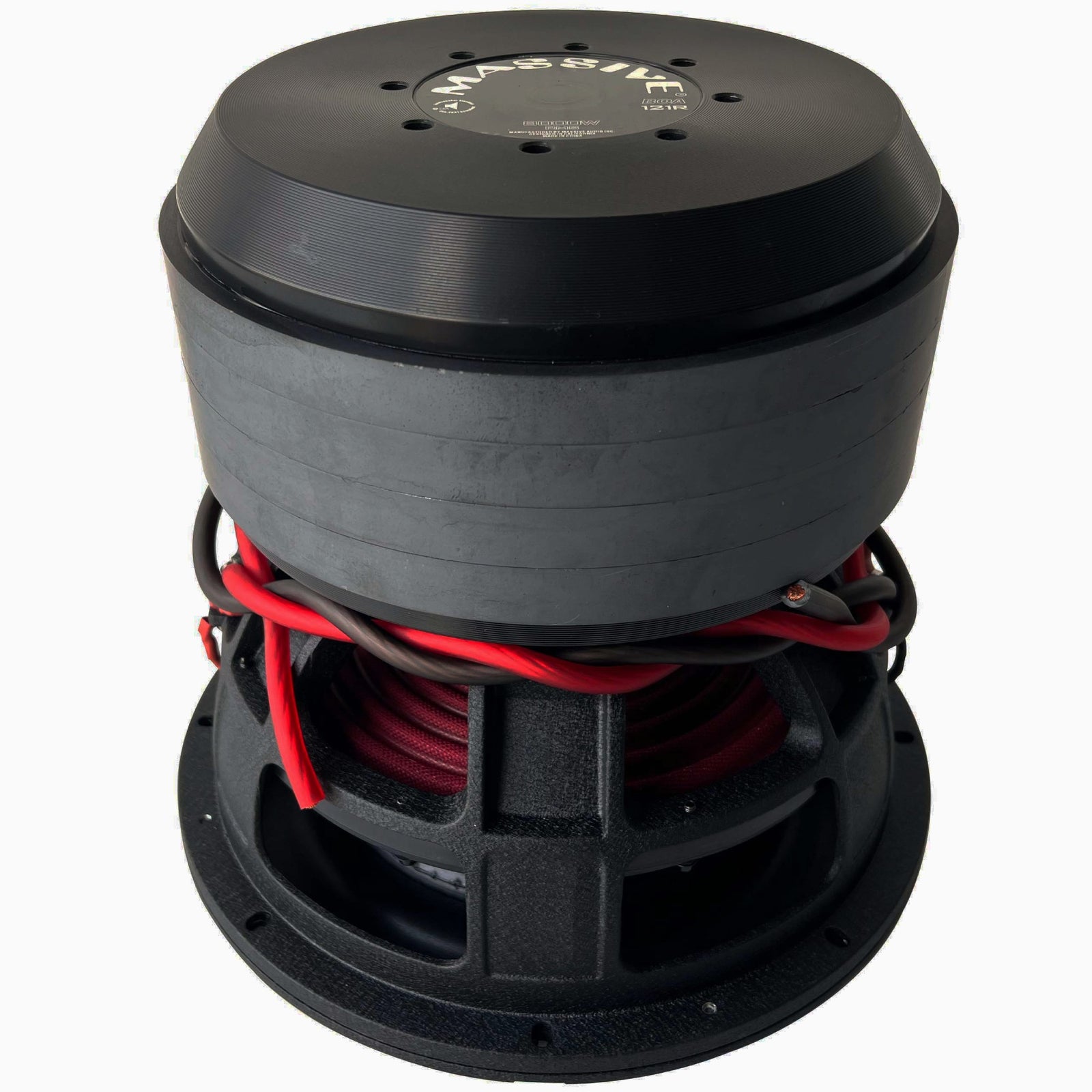
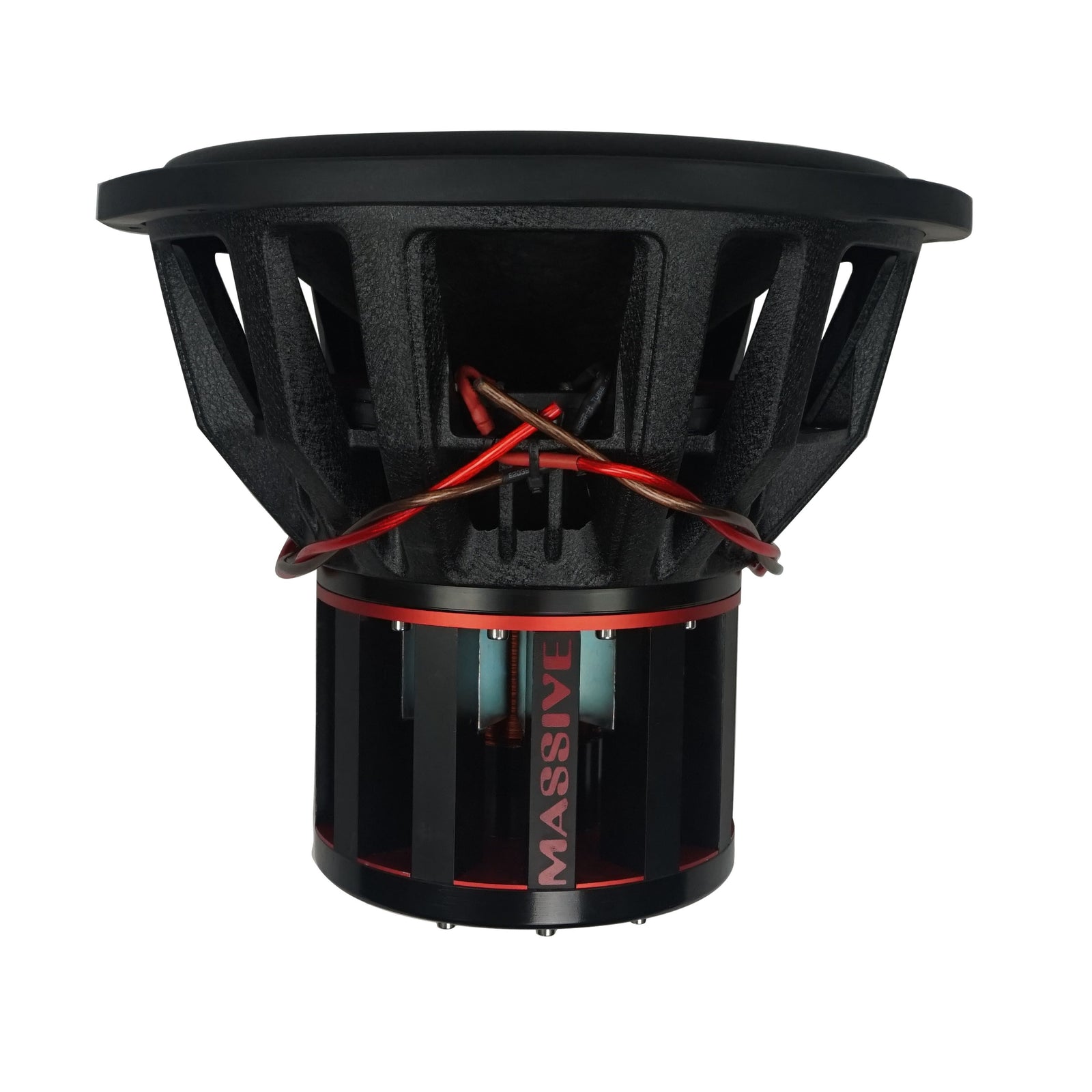
Every current BOA “R” model, whatever the cone size, uses the same motor spec on Massive Audio’s spec sheet: a 1,000 oz quad-stacked strontium ferrite magnet, a black anodized one-piece pole plate and a custom-tooled gasket and magnet boot.
What that means in practice:
- Strontium ferrite is the classic ceramic magnet material. It is far heavier than neodymium for the same field strength, which is why these subs weigh what they do, but it is cheap per unit of magnetic energy, stable with heat, and lets the builder stack a lot of it.
- Quad-stacked means four magnet slugs on top of each other. Stacking raises the total magnetic energy and lets the top plate and gap be made deeper. A deep gap with a strong field keeps the voice coil inside usable flux over a much longer stroke, and that is what lets a sub take huge excursion without the motor force falling off a cliff.
- Motor force (BL) is the number that tells you how hard the motor grips the coil. Massive Audio does not publish BL or any other Thiele/Small figure for the BOA line, so we can’t give you a number. What we can say is that a 1,000 oz stack driving a 4″ coil is built for control at very high power, not for light, easy efficiency at a few hundred watts.
- One-piece pole plate. A single machined pole and back plate avoids the small air gaps you get when separate parts are pressed together, so more of the magnet’s energy ends up in the gap where the coil is.
The older BOA models used a 470 oz triple-stacked strontium motor (or a 108 oz neodymium motor on the “-N” versions). The R series more than doubles the strontium, which is the main reason power handling went from 6,000 to 8,000 watts RMS.
The voice coil: 4″ flat-wound copper-clad aluminum
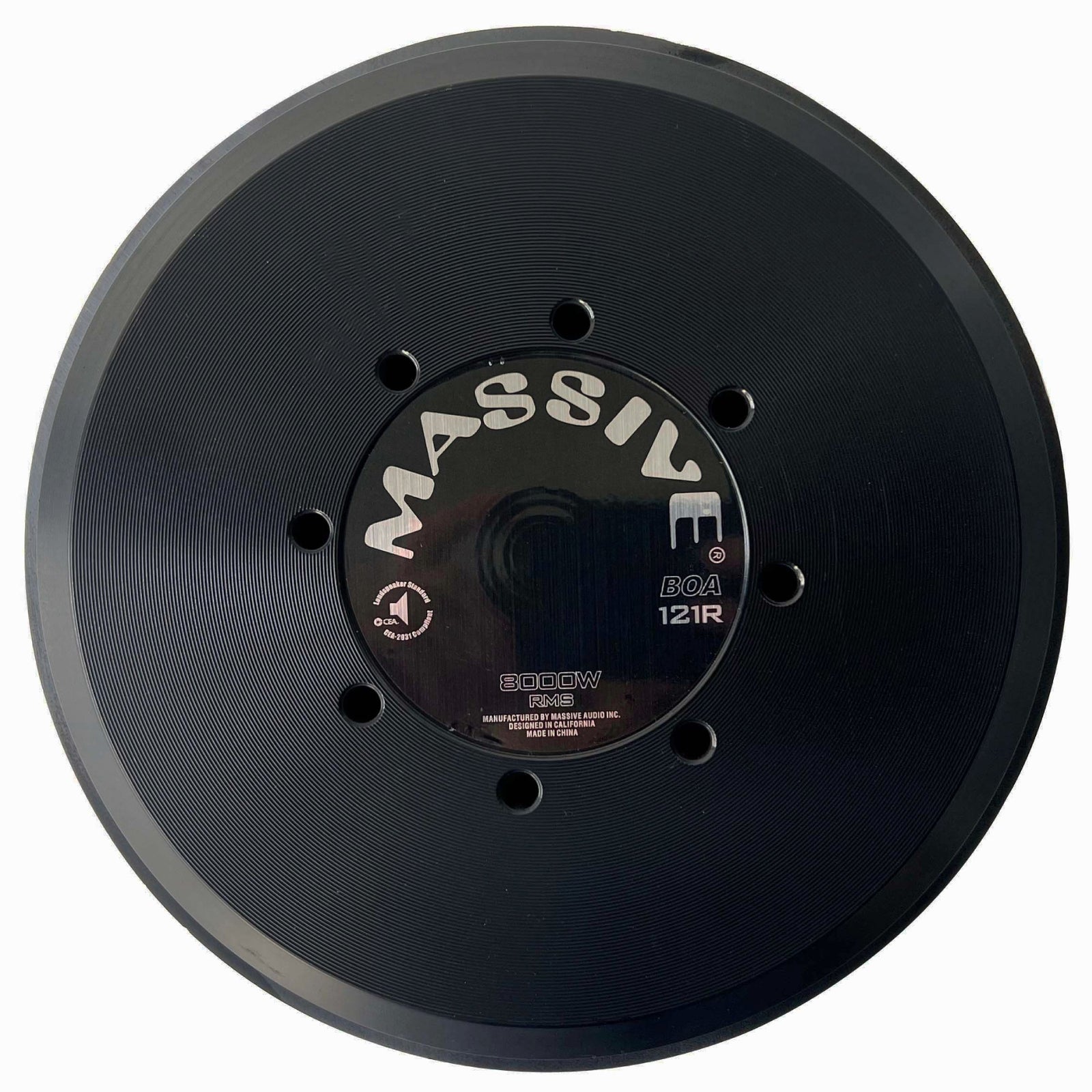
Massive lists the coil as 4″ flat copper clad aluminum, dual 1 ohm (BOA121R) or dual 2 ohm (BOA122R), wound on a black anodized voice coil former with Kevlar spunlace.
- 4″ diameter. A bigger coil has more wire and more surface area, so it can shed more heat. Heat is the real limit on how much power a sub can take for a long time, which is what the RMS rating describes.
- Flat (edge) wound wire. Flat ribbon wire packs tighter in the gap than round wire, so more of the gap is filled with conductor. More conductor in the field means more force per amp.
- Copper-clad aluminum (CCA). Aluminum is about a third the weight of copper, so a CCA coil keeps moving mass down. The copper skin makes the wire easy to terminate and solder. The trade-off is a bit more resistance per length than solid copper, which the design accounts for.
- Black anodized aluminum former. The former is the tube the coil is wound on. Aluminum pulls heat away from the windings, and the black anodizing helps it radiate that heat. The Kevlar spunlace layer stiffens the former so it does not deform when the coil is slammed back and forth.
- 8 AWG direct leads. Instead of spring terminals, each coil comes out on heavy 8 AWG pure copper wire. That matters at this power: 8,000 watts into a 0.5 ohm final load is roughly 126 amps RMS (I = √(P/R)), shared between the two coils. Thin leads and push terminals would turn into fuses.
- Heavy-duty triple tinsel leads carry the current from the leads to the moving coil and are built to flex millions of times at long excursion.
Cone, surround and suspension
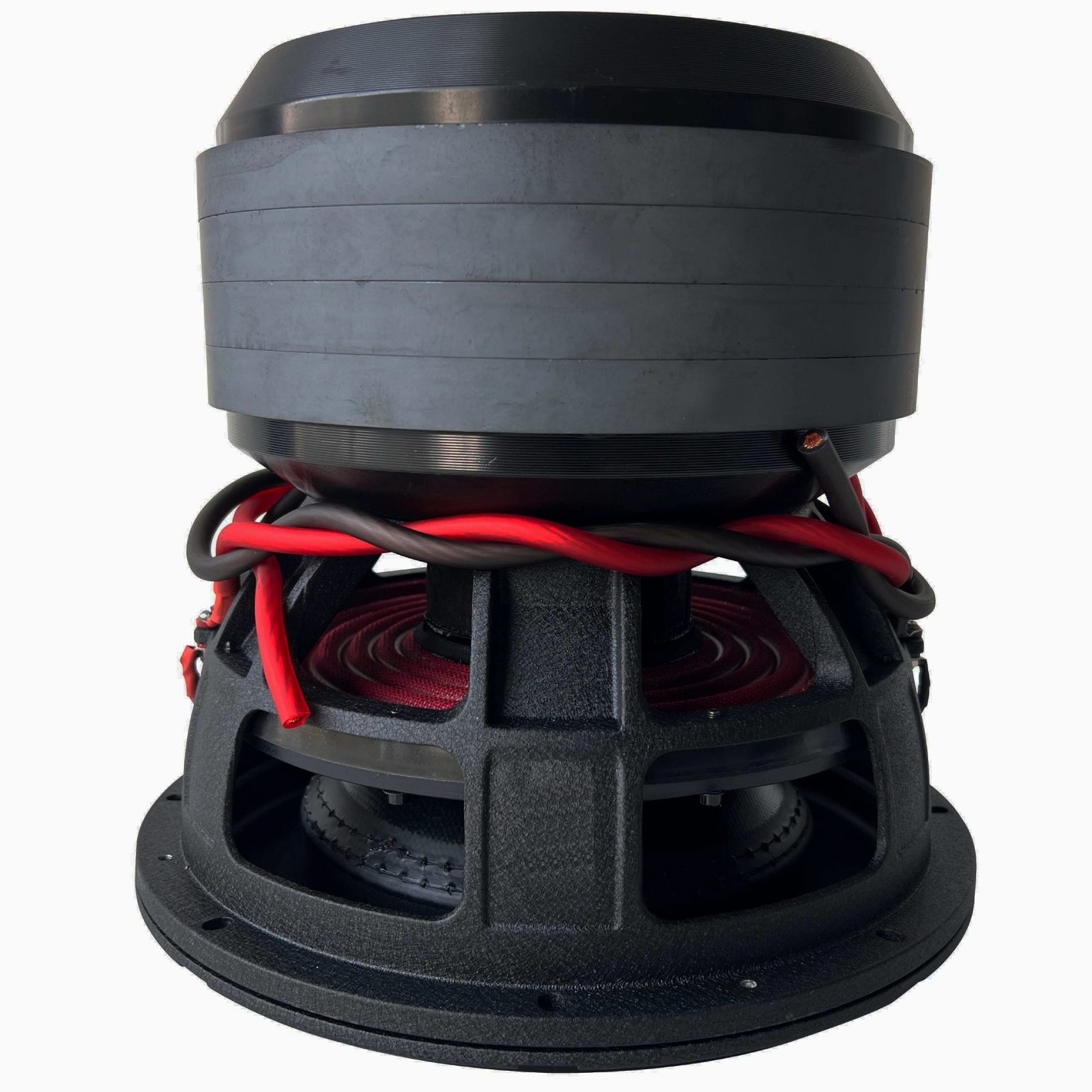
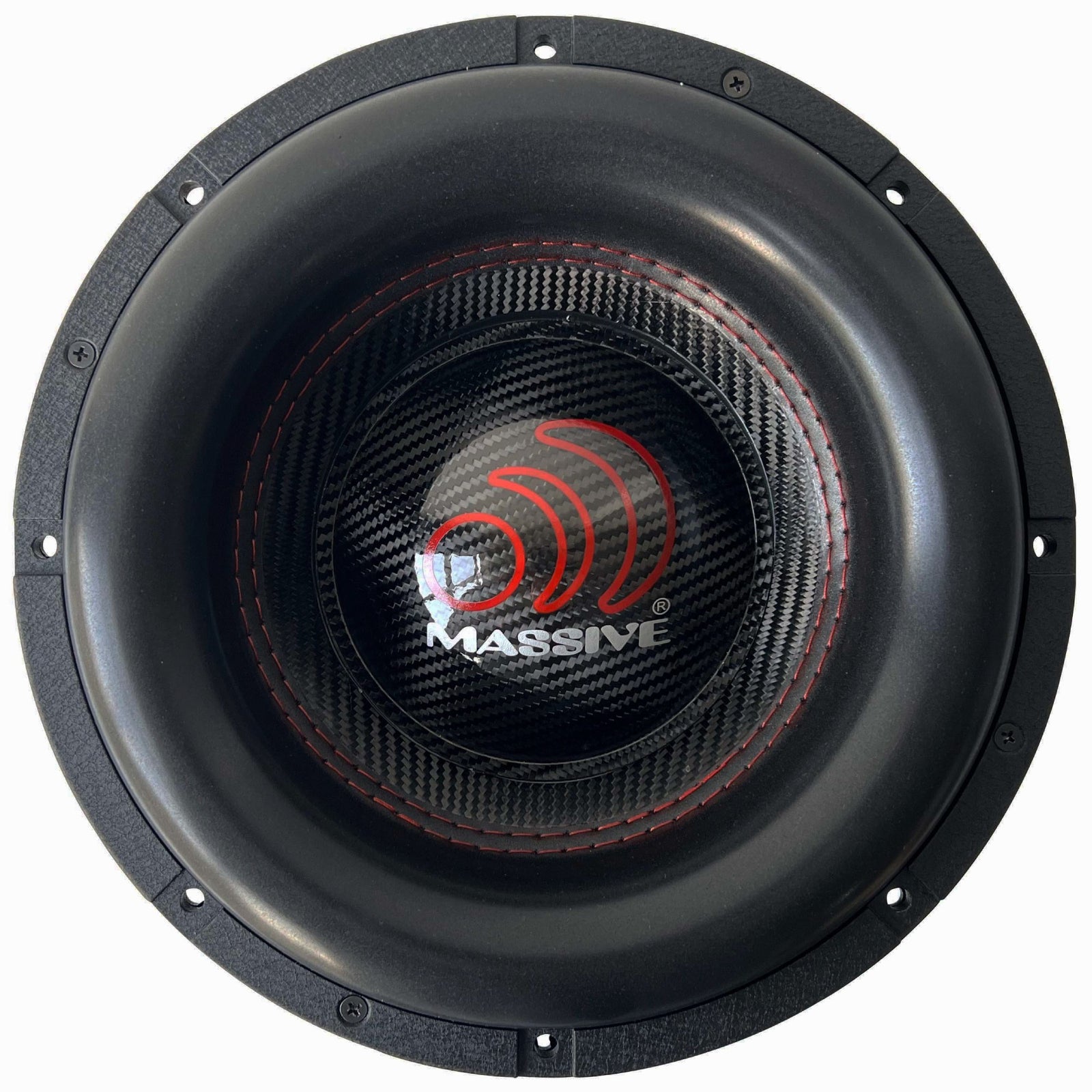
- Cone. Here Massive’s own page disagrees with itself. The spec table says “Carbon Fiber with Top Layer Shielded”, while the feature list says “Kevlar Fiber Reinforced Non-Pressed Paper Cone with Industrial Textured Finish.” Either way the goal is the same: a stiff, light cone that does not flex or “taco” when it is pushed with thousands of watts. Ask us and we will show you the actual unit on the bench.
- Dust cap. Reinforced woven fiberglass, which adds stiffness to the center of the cone where the coil drives it.
- Surround. Wide multi-layer EROM foam with red stitching. A tall, wide roll allows a long linear stroke. The stitching keeps the foam from tearing away from the cone at the extremes.
- Spiders. The feature list calls out over-sized mirror-image 6-layer poly/Nomex spiders and triple poly cotton spiders in a mirror-image layout. Spiders are the springs that center the coil. Mounting them as mirror images means the suspension is about equally stiff going in and coming out, so the cone does not drift to one side at high excursion. That keeps distortion down and keeps the coil from rubbing.
- Basket. Heavy-duty die-cast aluminum. A stamped steel basket would bend under a motor this heavy. Cast aluminum stays rigid, so the motor, coil and gap stay aligned.
Enclosure: sealed or ported?
Massive Audio describes the BOA R series as “designed for high-performance SPL.” Its own spec sheet gives a ported box spec and no sealed box spec at all for the 12″ models. That tells you how the factory expects these subs to be used.
Ported (recommended for BOA). A port uses the air in the box to resonate at the tuning frequency, which adds a lot of output around that frequency and takes stress off the cone there. For SPL that is exactly what you want.
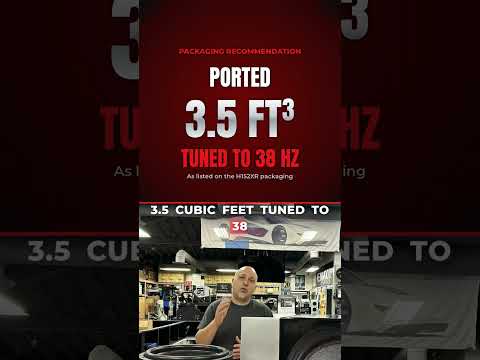
Massive Audio lists the R-series 12″ ported box as “Custom”, with no dimensions, volume or tuning. For reference, the discontinued 6,000 watt BOA121 was listed with a ported box of 17.4″ H x 20″ D x 18.9″ W with a 17.52 sq in port. Multiply those out and the gross outside volume is about 3.8 cubic feet before you subtract wall thickness, the port and the sub itself. We would not reuse that box for an R-series 12: the R motor is much bigger, displaces more air, and the sub is built to take 2,000 more watts.
In our builds, the box volume, port area and tuning are chosen for your vehicle and for what you want from it (daily or competition), then checked with a meter.
Port area matters at 8,000 watts. A common rule of thumb for SPL builds is about 12 to 16 square inches of port area per cubic foot of box. Too little port area causes port noise (chuffing) and compression, and the box stops getting louder no matter how much power you add. Many SPL builders go even bigger on purpose.
Tuning. Massive does not publish a recommended tuning. For daily listening most of our customers like a tuning in the low to mid 30 Hz range. For burps and meter numbers we tune higher, to match the vehicle’s own resonance, and the right number changes from vehicle to vehicle. We decide it with a meter in your car.
Sealed. A BOA can physically play in a sealed box, and a sealed box gives tighter, flatter low bass with less output. But with a motor and suspension this big, you give up most of what you are paying for, and since Massive publishes no T/S data or sealed volume, we would not build a BOA sealed box without measuring the driver first.
Build quality. These subs weigh about 150 pounds each according to Massive. The box needs heavy bracing, thick MDF or Baltic birch (often doubled on the baffle), and it has to be bolted down properly. An unsecured box this heavy is dangerous in a crash.
Want the short version on why the box matters this much? Watch our video below.
Amplifier matching and power
Each BOA R model is rated 8,000 watts RMS and 16,000 watts peak. RMS is the number to plan around. Peak is a short-burst figure and should never be used to size an amplifier. (We explain the difference in our short video, What is RMS in a speaker.)
Our rules of thumb for a BOA build:
- Match the amp’s RMS rating at your final impedance. Look at what the amp makes at the load you will actually wire to (for example 1 ohm), not its biggest number at 0.5 ohm. About 8,000 watts RMS per sub is the target. Running less clean power is perfectly safe. Running a clipped signal is what burns coils, not “too much” clean power. See also: why you need to choose the right amplifier.
- Set gains with a test tone and a meter or oscilloscope. At these power levels you can not set gains by ear.
- Plan the electrical system before the subs. An 8,000 watt class-D amp is roughly 80% efficient, so at full output it asks for around 10,000 watts from the car. At 14.4 volts that is on the order of 700 amps on paper. Music averages much lower than a test tone, but you still need the “Big 3” upgrade, one or more high-output alternators, a lithium battery bank, and multiple runs of true-gauge 1/0 OFC wire. A stock alternator will not support one BOA at full power. (Why current matters so much for SPL is covered in our short on heavy SPL bass and serious current.)
- Keep the sub inside its excursion limits. A subsonic (infrasonic) filter set below your box tuning stops the cone from unloading below tuning in a ported box.
Wiring and impedance
BOA121R (dual 1 Ω):
| Number of subs | Coil wiring | Final load | Notes |
|---|---|---|---|
| 1 | Coils in series | 2 Ω | Easy load for most big monoblocks |
| 1 | Coils in parallel | 0.5 Ω | Only for amps rated at 0.5 Ω |
| 2 | Each sub in series (2 Ω), subs in parallel | 1 Ω | The most common two-sub layout |
| 4 | Each sub in series (2 Ω), all four in parallel | 0.5 Ω | One big amp at 0.5 Ω |
| 4 | Each in series, two pairs in series, pairs in parallel | 2 Ω | Four subs on one 2 Ω stable amp |
BOA122R (dual 2 Ω):
| Number of subs | Coil wiring | Final load | Notes |
|---|---|---|---|
| 1 | Coils in series | 4 Ω | Low power from most amps, not ideal |
| 1 | Coils in parallel | 1 Ω | The usual single-sub choice |
| 2 | Each sub in parallel (1 Ω), subs in series | 2 Ω | Good for a 2 Ω stable amp |
| 2 | Each sub in parallel (1 Ω), subs in parallel | 0.5 Ω | Only for 0.5 Ω stable amps |
| 4 | Each sub in series (4 Ω), all four in parallel | 1 Ω | Four subs on one 1 Ω amp |
Always check what final load your amplifier is stable at before you pick a wiring option.
Who is the BOA 12″ for?
SPL competitors and “loudest car on the block” builds. This is what the BOA line is designed for: long excursion, a huge motor, 8 AWG leads and power handling to match. It is at home in a wall build or a big ported box with serious power behind it.
Daily drivers who want extreme bass. It works, but go in with the right expectations. You need the electrical upgrades above, a vehicle that can carry a very heavy sub and box, and you will usually tune lower for music than for meter numbers.
Sound-quality (SQ) listeners in a small sealed box. Not the right tool. A BOA wants space, power and a port. If you want tight, accurate bass from a small box on a stock electrical system, we will point you to a better match from our showroom.
The BOA 12″ family: R series vs the originals
The BOA name has been around for years. Massive’s site still shows the original 12s, now listed as discontinued, and the jump to the R series is easy to see:
| Model | Status | Coils | RMS / peak | Magnet | X-Max (2-Way) | SPL | Ported box (Massive) |
|---|---|---|---|---|---|---|---|
| BOA121R | Current | 4″ dual 1 Ω flat CCA | 8,000 / 16,000 W | 1,000 oz quad-stacked strontium | 48 mm | 90 dB | Custom |
| BOA122R | Current | 4″ dual 2 Ω flat CCA | 8,000 / 16,000 W | 1,000 oz quad-stacked strontium | 48 mm | 90 dB | Custom |
| BOA121 | Discontinued | 4″ dual 1 Ω | 6,000 / 12,000 W | 470 oz triple-stacked strontium | 25 mm | 88.9 dB | 17.4″ H x 20″ D x 18.9″ W, 17.52 sq in port |
| BOA121-N | Discontinued | 3″ dual 1 Ω flat wound | 6,000 / 12,000 W | 108 oz triple-stacked neodymium | 13 mm | 89.8 dB | 17.4″ H x 19.5″ D x 18.9″ W, 17.52 sq in port |
The neodymium BOA121-N was the light, efficient one. The R series goes the other way: more magnet, a bigger coil and almost twice the listed stroke of the original strontium BOA, in exchange for a lot more weight.
Every BOA model in pictures
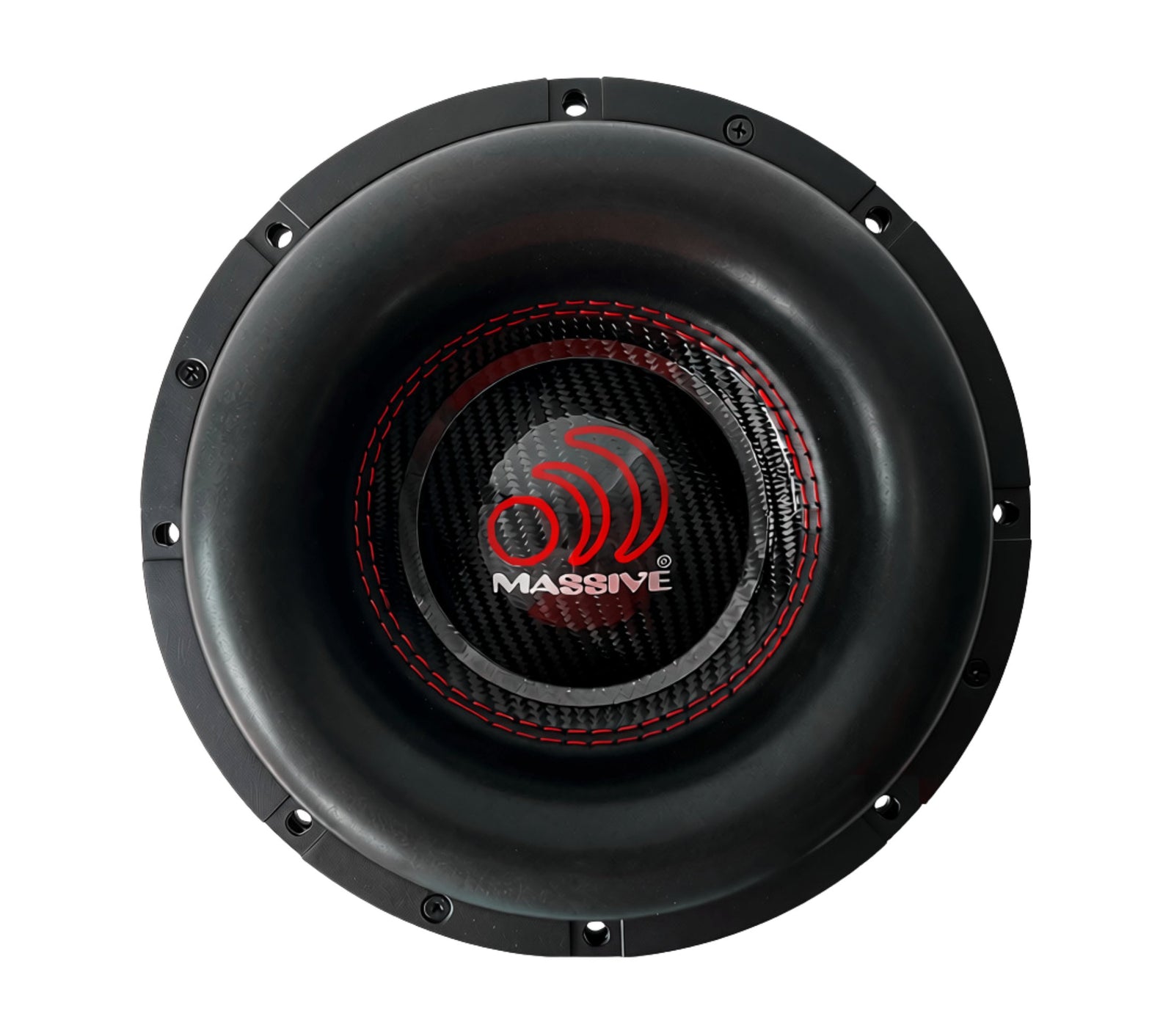
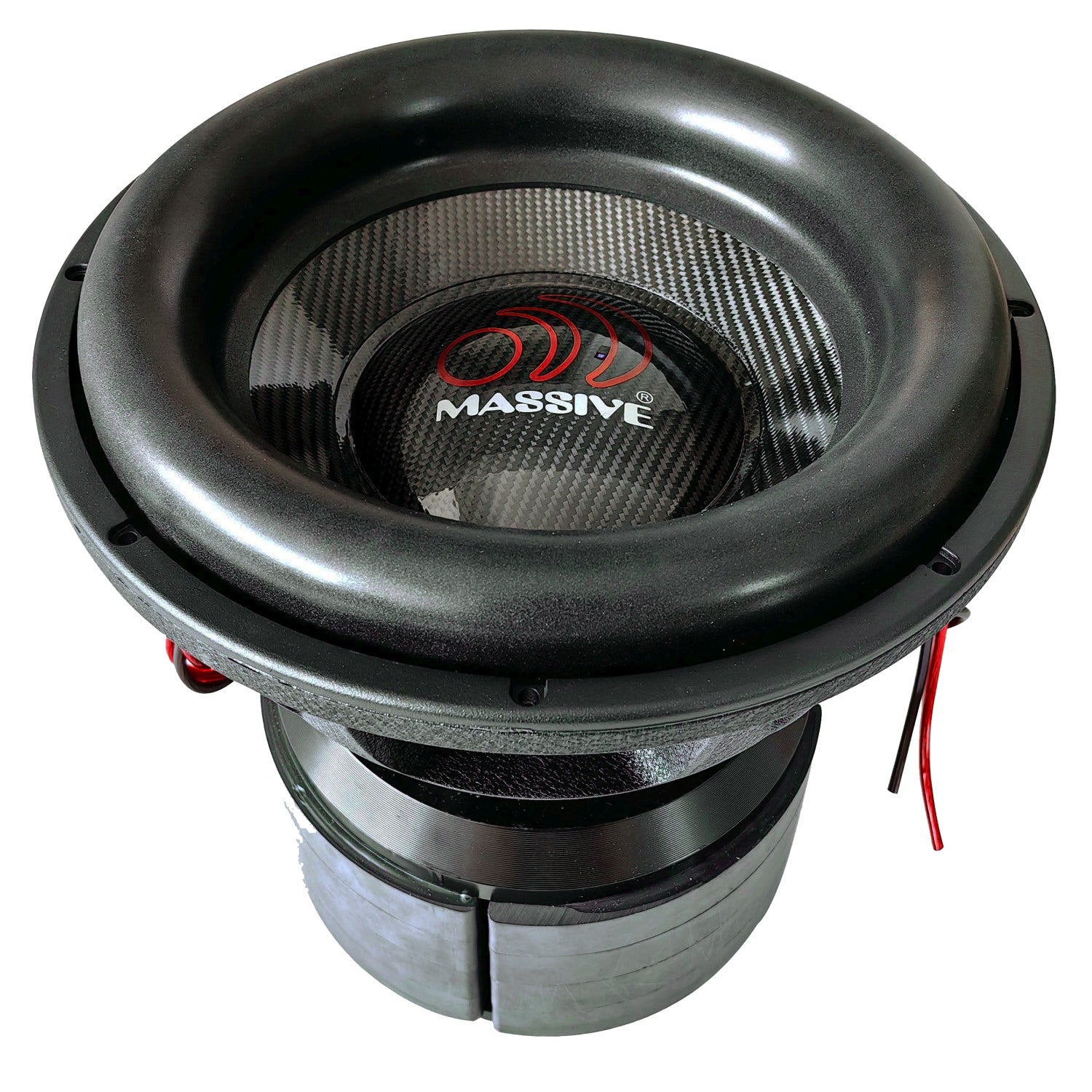
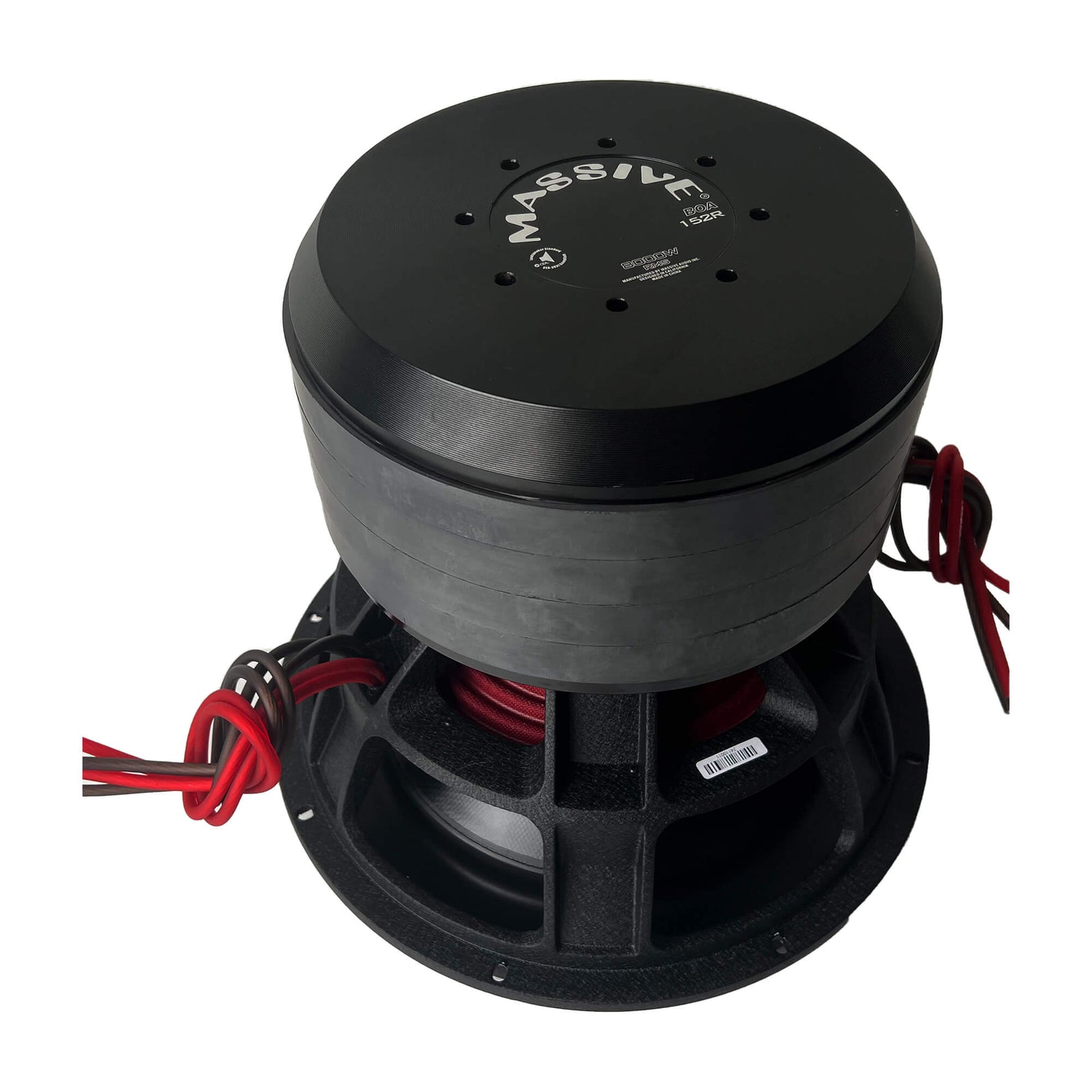
Here is the whole current BOA R lineup, plus the original BOA 12s it replaced. Click any photo for Massive Audio’s product page.
Frequently asked questions
Only the voice coil impedance. The BOA121R has dual 1 ohm coils and the BOA122R has dual 2 ohm coils. Power, motor, cone, X-Max and SPL ratings are listed the same.
Pick the one that lands on the load your amplifier is happiest at. For one sub on a 1 ohm amp, the BOA122R (coils in parallel) is the simple choice. For two subs on a 1 ohm amp, two BOA121Rs (each in series, then parallel) give you 1 ohm.
Massive Audio rates both at 8,000 watts RMS and 16,000 watts peak.
Massive lists the ported box as “Custom” and does not publish a volume, tuning or T/S data. The discontinued BOA121 used a ported box of 17.4″ H x 20″ D x 18.9″ W with a 17.52 sq in port, but that was a 6,000 watt sub with a different motor. We build R-series boxes to order.
Massive does not define “2-Way”. We read it as total travel (in plus out), about 24 mm each way. That is very long throw for a 12″.
Massive’s description says about 150 pounds (the shipping weight is 149 lb). Plan for a heavily braced box that is bolted to the vehicle.
The BOA121-N (neodymium) and BOA121 (470 oz strontium) are listed as discontinued on Massive Audio’s site. The current 12s are the BOA121R and BOA122R.
Yes. Customers come to our Riverside shop from all over Southern California: Los Angeles, Orange County (Anaheim, Irvine, Santa Ana), and the Inland Empire (Corona, Moreno Valley, Jurupa Valley, Norco, Ontario, Rancho Cucamonga, Pomona, San Bernardino). For a big project you can also send your vehicle to us on a flatbed truck to make it easy. Call (951) 358-0516 to set it up.
Watch more from our shop
All of these are filmed at our Riverside shop. Subscribe to Advanced Car Stereo Riverside on YouTube for new builds every week.
- Meet the King of SPL: the Massive Audio BOA152R, the 15″ version of this sub
- Ready for serious bass? The Massive Audio Hippo XL122R, another Massive 12″ we install
- Let’s build the right SPL formula for your truck
- Let’s talk serious SPL: matched subs, amplifiers and a custom box
- Why the right subwoofer box is so important
- How to get clean bass: the right subwoofer, amp, box and wiring
- What is RMS in a speaker
- Why you need to choose the right amplifier
- Heavy SPL bass demands serious current
- Introduction to Advanced Car Stereo in Riverside
Related reading from our blog
- Massive Audio SPL builds in Riverside: H5000, H8000 and big subs
- Massive Audio Hippo XL152R and H8000: an 8,000 watt SPL build
- Custom fiberglass and Plexiglass subwoofer enclosures in Riverside
- Choosing the best subwoofer for your car: a complete guide
BOA 12″ subwoofer installation in Riverside, CA, serving LA, Orange County and the Inland Empire
We install Massive Audio BOA subwoofers at our shop in Riverside, and we build the enclosure, the amp rack and the electrical system to match. Customers drive in from all over Southern California: Los Angeles, Orange County (Anaheim, Irvine, Santa Ana), and the Inland Empire (Riverside, Corona, Moreno Valley, Jurupa Valley, Norco, Ontario, Rancho Cucamonga, Pomona and San Bernardino). Come hear a BOA in person, or call and we will plan your BOA 12″ subwoofer build with you.
- Visit: Advanced Car Stereo Riverside, 10555 Magnolia Ave, Riverside, CA (get directions)
- Call: (951) 358-0516 or book an appointment
- Big project, far away? You can send your vehicle to us on a flatbed truck to make it easy. Call us and we will set it up.
- Custom installs: enclosures built for your vehicle, amp matching, gain setting, Big 3 and alternator upgrades
- Financing: see our financing and leasing options or apply for no credit check financing and get an approval decision fast, so your build does not have to wait.
- YouTube: youtube.com/@AdvancedCarStereoRiverside
Specifications in this article come from Massive Audio’s product pages as of November 2026 and are subject to change by the manufacturer. Where Massive does not publish a figure, we say so instead of guessing.


