
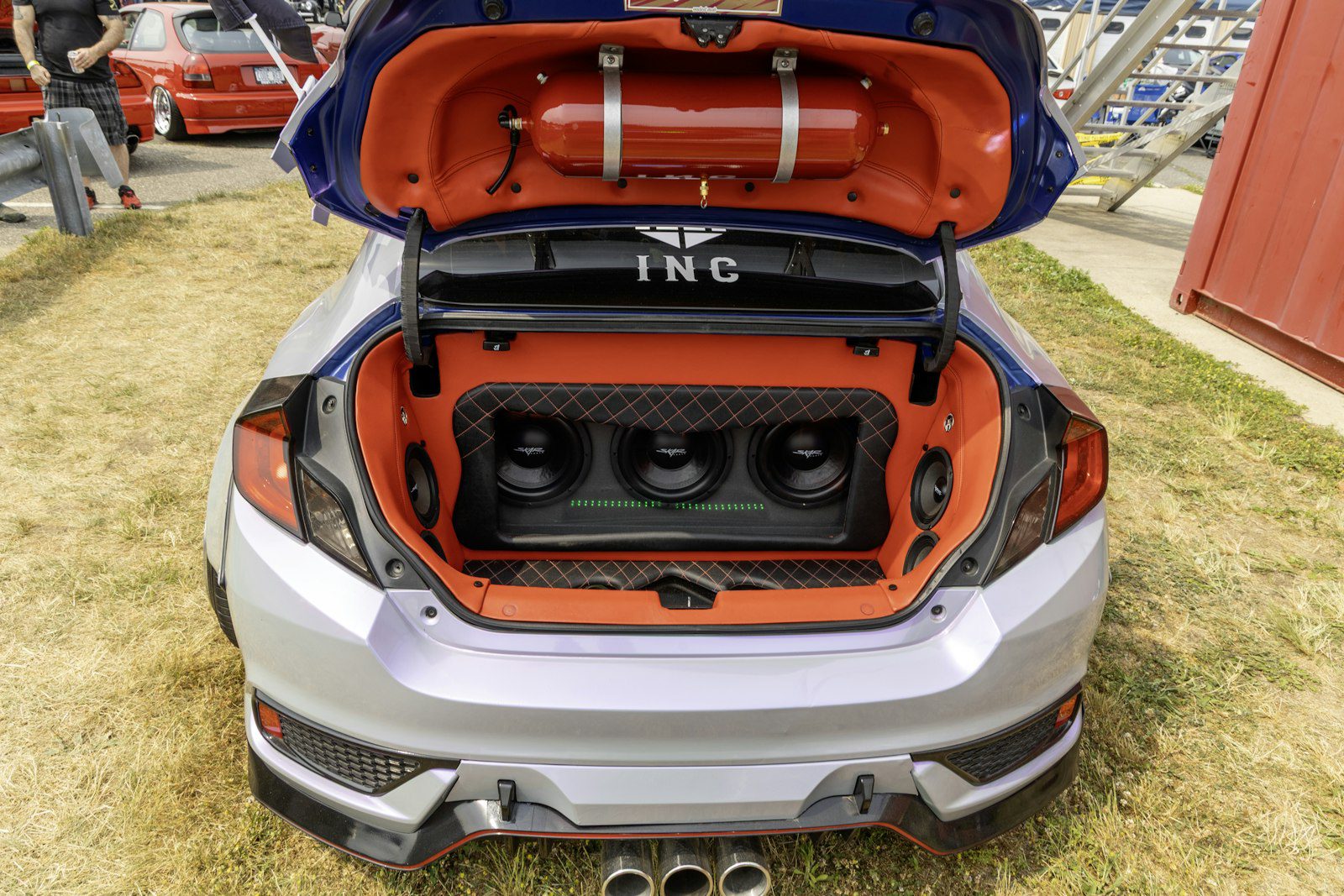
A subwoofer is only as good as the box it lives in. You can buy the most expensive sub on the market, put it in the wrong enclosure, and it will sound worse than a budget sub in a box that was engineered for it. That is why custom subwoofer enclosures are one of the most important services we offer at Advanced Car Stereo Riverside. We design and build enclosures from MDF, fiberglass and acrylic (Plexiglas), including stealth enclosures that disappear into your vehicle and show builds with lighting that put your bass on display.
This guide explains how enclosure design actually works, when fiberglass is the right material, how we build a fiberglass enclosure step by step, and what goes into a Plexiglas show build. If you are planning a custom system, our financing options let you build it the right way instead of settling for a prefab box.
Why the enclosure matters more than most people think
A subwoofer moves air in both directions. Without an enclosure, the sound from the back of the cone cancels the sound from the front, and most of the bass disappears. The enclosure controls that rear wave, and in doing so, it controls how the subwoofer behaves:
- Volume (internal air space) changes how deep and how tight the sub plays. Too small and the bass sounds choked and peaky. Too large and the sub loses control and can be damaged at high power.
- Enclosure type (sealed, ported, bandpass) changes the efficiency and the character of the bass.
- Port tuning in a ported box sets the frequency where the box gives the biggest boost.
- Construction (wall thickness, bracing, sealing) decides whether the box stays rigid or flexes and wastes energy as vibration and rattles.
Every subwoofer has published Thiele/Small parameters (values like Fs, Qts and Vas) that describe how it behaves. We use those numbers, along with the vehicle’s cabin size and your listening goals, to calculate the right enclosure, instead of guessing. For more background, read our guide to choosing the best subwoofer.
Sealed, ported and bandpass enclosures
Sealed enclosures
A sealed box is airtight. The trapped air acts like a spring that controls the cone. Sealed enclosures give tight, accurate, musical bass with excellent transient response, and they can be smaller. They need more power to get loud. Sealed is a great choice for sound quality builds and for tight spaces.
Ported (vented) enclosures
A ported box uses a tuned vent so the air in the port reinforces the sub’s output around the tuning frequency. Ported boxes are louder per watt, often by 3 dB or more around tuning, which is like doubling your amplifier power in that range. They are larger and need careful design. Ported is the standard for most SPL and “big bass” builds.
Bandpass enclosures
In a bandpass enclosure, the sub fires into a chamber and all of the sound exits through a port. They can be extremely loud in a narrow band and are used in some competition and specialty builds. They are less forgiving and need precise design.
MDF vs fiberglass vs acrylic
MDF
Medium-density fiberboard is the workhorse of car audio. It is dense, dead (it does not ring), easy to cut accurately and affordable. Most rectangular and wedge enclosures, and most ported SPL boxes, are made from MDF, often 3/4″ or thicker with internal bracing.
Fiberglass
Fiberglass lets us build an enclosure in almost any shape. That is its superpower. We use fiberglass when we need to:
- Fit a subwoofer into a spare tire well, a side trunk panel, a quarter panel or the corner of a hatch.
- Build a stealth enclosure that looks factory, so you keep your cargo space and nobody knows the system is there.
- Mold kick panels, A-pillar pods for tweeters, and custom door panels for midbass drivers.
- Create sculpted show pieces with flowing curves that MDF cannot make.
Fiberglass is labor intensive, and that is reflected in the price. It is also a skill that separates a true custom shop from an installer who only bolts in prefab boxes.
Acrylic (Plexiglas)
Acrylic is used for windows, trim rings, sub covers and full show panels. With LED lighting behind or inside it, acrylic turns your trunk into a display. It can also be laser engraved with logos or your vehicle’s name.
Subwoofer brands we design enclosures for, from value to luxury
An enclosure has to be designed around a specific subwoofer, so brand and model matter. Here are the brands we work with most, and why customers choose them.
Massive Audio
Massive Audio’s HippoXL subwoofers and high-power amplifiers are built for SPL. They need large, well-braced ported enclosures and serious electrical support. See our Massive Audio SPL builds for real examples.
Rockford Fosgate
From the Punch line to the Power T1 and T2, Rockford Fosgate covers everything from daily-driver bass to competition output. Their published parameters make enclosure design precise.
Kicker
Kicker’s square Solo-Baric L7 subs give more cone area in the same space, which is perfect for tight fiberglass and stealth enclosures. Their CompQ and CompR lines are great value; read our CompQ 12″ review.
JL Audio
JL Audio’s W6v3 and W7AE subwoofers are legendary for deep, accurate bass. The W7’s patented design delivers huge excursion with low distortion. JL also makes shallow-mount TW3 and TW5 subs that are ideal for stealth enclosures.
Audison, Hertz and Morel: the luxury tier
For high-end sound quality builds, we design enclosures for Audison and Hertz Mille subwoofers and for Morel drivers, which are known for refined, musical bass. These brands pair perfectly with sealed fiberglass enclosures and acrylic show work. Read our guide to why premium car speakers cost $2,000 and up.
Musway and Focal
Musway offers vehicle-specific and high-end systems that are popular with luxury car owners (see why luxury owners are upgrading to Musway), while Focal brings French high-fidelity engineering to subwoofers that excel in sealed enclosures.
The luxury build
Our top-tier enclosure builds combine a premium subwoofer, a fiberglass enclosure molded to the vehicle, color-matched leather or suede finish, an acrylic window, edge-lit engraved panels and a DSP tuned in the car. That is the difference between a box in the trunk and a piece of engineering you are proud to show.
How we build a fiberglass enclosure, step by step
- Design and calculations. We pick the subwoofer and calculate the target internal volume and enclosure type. With odd shapes, we plan extra volume for the sub’s displacement and the internal bracing.
- Protecting the vehicle. We mask and protect the area with tape and plastic so the resin never touches your paint, carpet or trim.
- Mold the shape. We lay fiberglass mat directly against the vehicle’s contours (or stretch fleece over a frame for curved shapes) so the enclosure fits perfectly.
- Build up the layers. Multiple layers of mat and resin are applied until the walls are thick and rigid. A sub enclosure needs to be stiff; a thin fiberglass shell flexes and loses bass.
- Add the baffle. We build an MDF mounting baffle and ring to hold the subwoofer accurately and seal it to the shell.
- Measure the volume. We verify the actual volume and adjust if needed, so the sub gets the space it was designed for.
- Reinforce and seal. Internal bracing, resin sealing on the inside, and an airtight terminal cup.
- Finish. Sanding, body filler and a final finish: carpet, vinyl, suede, paint or a wrap that matches your interior.
- Install and tune. The enclosure is mounted securely and the system is tuned in the vehicle.
Plexiglas and lighting show builds
A show build combines enclosure engineering with presentation. Popular options include:
- Acrylic windows that show the subwoofers inside a sealed or ported box.
- Floating amp racks with acrylic panels and hidden wiring.
- LED lighting (single color or RGB, music-synced if you want) to light the build.
- Engraved logos and edge-lit acrylic panels.
- Trunk and hatch false floors that combine audio, lighting and finish work.
A show build still has to sound right, so we design the enclosure first and the display second. Lighting is wired to its own fused circuit and switched so it never interferes with the audio system. For more lighting ideas, see our custom car lighting guide.
Stealth enclosures: keep your trunk, keep the bass
Not everyone wants a box in the trunk. Stealth enclosures fit into empty spaces that already exist: the spare tire well, behind side panels, under the rear seat in trucks, or in the corners of SUVs and hatchbacks. With fiberglass, we can use those odd spaces and finish them to match the factory interior. In trucks, where space behind the seat is tight, we often combine custom enclosures with interior reconfiguration, as we explained in our Dodge Ram SPL system build.
What affects the cost of a custom enclosure
- Material and size. MDF is faster to build; fiberglass and acrylic take more time.
- Complexity. Curves, multiple chambers, ports and windows all add labor.
- Finish. Carpet is quickest; paint, wraps and color-matched upholstery take longer.
- Lighting and display features. Acrylic work, engraving and LED integration.
- Vehicle work. Removing and modifying interior panels and adding electrical upgrades.
We will give you a clear quote after we look at your vehicle and goals, and you can spread the cost with our financing and leasing options.
Frequently asked questions
Is a custom box really better than a prefab box?
Usually, yes. A prefab box is built for an average subwoofer in an average vehicle. A custom enclosure is built for your subwoofer, your vehicle and your goals, and it can use space a prefab box cannot.
Will a fiberglass enclosure rattle or crack?
Not when it is built with enough layers and proper bracing. Rattles usually come from thin shells, poor mounting or loose interior panels, and we address all three.
Can you match my interior?
Yes. We can finish enclosures in carpet, vinyl, suede, leather or paint that matches your interior.
How long does a custom enclosure take?
A simple MDF enclosure can be quick. A fiberglass or show build takes longer because resin needs to cure between steps. We will give you a timeline before we start.
Do I need electrical upgrades too?
For high-power systems, often yes. We review your charging system as part of every build.
Why Riverside chooses our engineering team
We calculate enclosures instead of guessing, we build with fiberglass when the vehicle calls for it, and we tune every system in the car. Our technicians train to industry standards (we run MECP training in house), and our work ranges from quiet stealth builds to 8,000-watt SPL builds.
What makes us different: Riverside’s only shop with its own installer school
Building a fiberglass enclosure that measures right, stays rigid and fits like it came from the factory is a skill that takes years to learn. It is also exactly the kind of skill we teach.
We are the only shop in Riverside that runs its own hands-on installer school. Our Master Car Audio Installation Boot Camp teaches students the craft inside our working shop: power and ground, wire gauge and voltage-drop math, signal flow, amplifier classes and gain setting with a meter, enclosure design, DSP tuning with an RTA, and professional troubleshooting. We also run car audio installation workshops, 3-day window tint and vehicle wrap courses, and MECP training.
Why does that matter to you as a customer? Because a shop that teaches the trade has to master it first. Every method we teach is a method we use on your vehicle, and our instructors are working installers who are on the shop floor the rest of the week. When you have to explain to a classroom why a connection, a fuse or a ground is done a certain way, there is no room for shortcuts. That is how we became the master of our domain, and it is why other installers come to us to learn.
- 35+ years at the same Riverside location, with the same standards.
- We train installers, so our own team works to a teaching standard every day.
- Engineering first: we measure, calculate and test instead of guessing.
- One shop for the whole vehicle: audio, lighting, security, tint, PPF, wraps, wheels, tires and suspension under one roof.
- Flexible payments with financing and leasing options.
Visit Advanced Car Stereo Riverside
📍 10555 Magnolia Ave, Riverside, CA 92505 (get directions)
📞 (951) 358-0516
🕘 Open 7 days, 9am to 6pm
Ready for an enclosure built for your car and your sub? Book an appointment or call us to plan your build. Ask about financing and no credit check options.
Financing subject to approval. Ask in store for full terms and details.
Finance your upgrade with no credit check
Get the upgrade you want today and pay over time. Apply for our No Credit Check financing, or see all of our financing and leasing options. Financing is subject to approval; ask in store for details.


